Work Text:
The Caucasus, 1860s
Once upon a time, there was a man who had three sons. The first son was born of sunlight and gale; he shrouded himself in radiance and gold and swept across all four corners of the earth like a solar storm. The second son was born of sea and thunder; he wore the armour of the warrior and wielded judgment like a lightning bolt. The third son was forged from earth and fire; he walked in shadows and carried the torch of vengeance like a flaming sword.
At the shores of the Black Sea, the brothers parted. One went south, two went north, towards the endless steppes, towards the Silk Road, towards snow-capped peaks that scraped the skies.
Along the green slopes of the Caucasus mountains, two horsemen rode towards the setting sun, their servants trailing in their wake. “Not far now,” one of the riders spoke, shielding his eyes from the red sun. Even though he wore the costume of a Cossack from the Russian steppe, his hat with its wide brim was of a European cut. He had pulled it down so that his face remained in shadows. When he turned his head to speak to his companion, a ray of light slashed across his brow and his eyes glittered like mercurial waters at the bottom of a well.
The other rider smiled, a sad smile that was centuries older than his young face. “Are you sure you don’t want to come along, Aramis? Afterwards we will travel to Wallachia to visit your family.”
Aramis raised his head towards the mountain range; eyes and teeth flashed in the lily-white face. “I don’t have any family. And I have little fancy for a trip to another one of your holy mounts, I don’t believe they agree with me.”
“I seem to remember you rather enjoyed meeting my family on Olympus for the first time.” The smirk on the handsome face deepened. “And that was before you and the God of Plague had a lot to talk about.”
“You better watch that smart mouth of yours, Athos.” The brim of the hat lowered, the glittering eyes dimmed. “The last time we encountered your family, they tried to drown us.”
“I believe the last time we encountered my family, you killed the Din of War.”
“Oh.” A shadow of embarrassment flickered and died. “Yes, I believe you’re right.” The soft voice grew softer still. “Is this why you wish me to join you on your ascent of Mount Elbrus? Do any of your relatives dwell there whom you want me to… meet?”
Athos laughed. “Not since Prometheus left, and I wouldn’t want you to… meet him. He’s Porthos’ relative rather than mine anyway. And I’m fairly certain that you would like him. I always did.”
“He defied the gods and was punished for his impudence,” Aramis mock-mused. “Yes, I can see how he’s a kindred spirit, Discord. It’s a shame he’d been freed by Hercules, or you could have done the honours.”
“You could’ve helped.”
“Your father will be disappointed that you wish to honour the memory of Prometheus. He might try to smite you. Again.”
“I’m not sure if Father remembers him. It happened many millennia ago, and the Olympians haven’t been in touch with the affairs of humans in a long time.”
“Fortunately.”
“Is it?” Another smile accompanied the quick sidelong glance. “Are humans truly better off under the rule of your One God, Aramis?”
A snarl curled the soft mouth, a flame set the mild features ablaze. “Aren’t you?”
Athos shrugged. “Your god never did anything for me. He is not just, Aramis: he gives the rich everything and the poor nothing.”
“He gave you me.”
Athos laughed again, reached out and took Aramis’ hand. “Touché! He did that, my love. And I am grateful.”
“You better be.”
“I shall give thanks most fervently. On my knees. Would you like that?”
“I’m still not coming to Elbrus with you.”
“What’s the worst that can happen?”
“Oh let’s see: your Thunderous Father might awaken. The eagle might swoop down eat your liver. Perhaps even your heart – how good is an eagle’s grasp of human anatomy? Your family might gang up on you and chain you to the rock for all eternity.”
“Surely not for all eternity. You’d come and rescue me, chyortik.”
“You deviant.” The black eyes narrowed. “Is this what you’re hoping for? To get imprisoned in Prometheus’ stead?”
“Not to forget the Persian demons who had been banished to Elbrus for their sins. Would you raise an army to free your demonic kin?”
“Demons only lure in people with their tricks and mummery, as well you know.”
“Would you raise an army to free me?”
“Here?” Aramis looked around pointedly, across the Svanetian mountain slopes and peaks. “This is bandit country.”
“You’d enjoy being the bandit chief, Aramis. To have them in your thrall and lead them to conquer the Holy Mount. Think about it… I know I will.”
“Deviant.
At the crossroads, the brothers parted. One went north, the other went west.
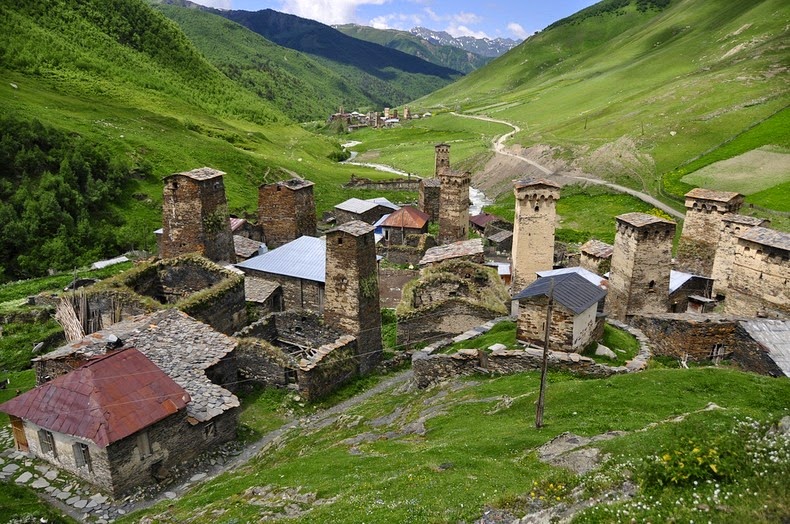
West, towards the blood-red sky, towards mountain peaks like molten copper. Along the foothills of Mqinwari and Bethleemi, where the iron chain was suspended by which one could ascend the cradle of Christ and the tent of Abraham.
This was bandit country. Yet the solitary horseman rode down the winding mountain paths without fear. Mountain walls glared to his left, an endless gorge boomed to his right.
Behind him, his servant followed on a mule and led another one laden with riches of the Orient. A cross hung around the horseman’s neck, and his wide-brimmed hat gave him the appearance of a pilgrim in the fading light.
He rode for seven days and seven nights. Each morning, the eagle flew above his head. Each night, the leopard roared. Svanetian horsemen appeared on the slopes like ghosts and vanished in air that was as clear as ice.
On the eighth day, he reached the village of Adishi. Faces turned to watch him: the faces of women in the doorways, and the faces of men high in the towers. He stopped, alighted and walked slowly towards a stone house, and the cross on his chest shone like the Most Sacred Heart of Jesus. He bowed with much grace and smiled with all his teeth.
The Church of St. George where the Adysh Gospels were kept was not more than a chapel, its walls adorned with murals that showed St. George slaying the dragon. Aramis leafed through the illuminated folios, touching the pages with gentle fingertips clad in silk gloves. The Asomtavruli script was familiar by now, but his grasp of the Georgian language was insufficient for deciphering the ancient texts. Guided by the monk who spoke Old Church Slavonic that made Aramis think of those long-gone summer days in Varna and Krakow, he found the passages in Matthew and in Mark, where the text read “rope” instead of “camel”, and he smirked.
A woman came into the chapel, whispering feverish words to the monk. He listened, nodded, and then turned to Aramis. “You are a scholar, Vashe Blagorodiye. Do you perhaps know the art of healing?”
Aramis looked up and smiled.
He was led into a house that crouched next to its own stone tower. The ground floor was spacious and dark, the open hearth the only source of light. Along the walls stood lavishly decorated wooden partitions behind which the cattle grunted and ruminated and kept the family warm in winter. Above them were the beds of the human occupants.
Aramis threw off his coat and swung himself on top of the wooden partition where the sick man lay. Behind him, by the wall, stood a tall, bony figure in a black cloak. Light glinted on the blade of her scythe.
“Good evening, Aramis.”
“Good evening, Sudarynya.” He looked up at her and then down at the man, whose face gleamed in the dark with a greenish sheen. The odour of sepsis rose from sheets and straw. “Is there any point to this?”
“What do you think, doctor?”
Aramis’ face was a white mask. “Why would you reveal yourself to me?” he asked quietly. “You had countless chances to show yourself to me. And yet, you never did. Why now?”
“I’ve walked by your side for many centuries, Aramis.”
“Do you want to take me?”
“Only if you wish me to.”
Aramis hesitated. “No. There used to be a time when I- But not now.”
“Good.” Death nodded and suddenly stood closer. So close that Aramis felt the marrow-deep cold that radiated from the white bones and the mantle of darkness. “You and I have a kinship, Aramis.”
He blinked. Italy in 1629. A daimon swept the lands on black wings. Where his shadow fell, life withered and died. Where his breath turned, it sucked the air out of human lungs and filled them with blood. Black Death skulked on the slopes of volcanoes, stalked proudly across green plains and rolling hills, lurked in the shade of olive groves, and thundered across rivers and streams on his black horse.
“Yes. We do.” He smiled, showing her all his teeth. “You and I are practically family.”
“If you so wish.”
“Смерть кума,” he whispered and laughed softly. “What is my part of the bargain? One of my souls?”
“I am not interested in souls, Aramis. I am not the devil. I do not trick, I do not lie. I call everyone, sooner or later: the rich and the poor, the beggar and the czar. I am just.”
“What, then?”
Death leaned in and dragged the bone of her forefinger over Aramis’ forehead, a baptism of fire-ice.
“You are a good doctor. I will make you a great doctor. Listen carefully: if you see me at the foot of the sickbed, help him, for he will live. If you see me at the head of the sickbed, you must not attempt to heal them, for he must die.”
“What is the benefit for me?”
“Every patient you treat will live. You will become the most celebrated physician in the world.”
“What is the benefit for you?”
Death shrank back into the shadows, trailing the tendrils of her cloak behind herself. “I am old, Aramis,” she spoke, and her voice rose from the depth of the tomb, a dead cold, not the cold this earth, but the cold of the cosmos that is ether’s endless ice. “I am old and there is no-one but me. Now, there is you.”
“No.” He clasped the cross and closed his fingers around it. “I cannot agree to this bargain.”
Death appeared taken aback. “Why not?”
“You are standing at the head of the sickbed now,” Aramis said. “And yet, these people see me at the sick man’s side. I am already treating him. I cannot refuse now. What you suggest will not make me great, it will make me hated.”
“He is just a man.”
“He is now my patient.”
Death fell silent, and Aramis began to unwrap the bandages, breathing through his mouth. “Bartleby!” he called. The leprechaun was already there, handing him his bag.
“But he will die,” Death said.
“Humans die. When life hangs in the balance, what humans want is not certainty; it’s hope.”
“Hope,” Death spoke slowly. “I do not know hope.”
“No.” Aramis picked up a syringe and a vial with morphine. “You don’t. Bartleby! Come up here and bring the saw.”
“Is there nothing I can give you?” Death said, and Aramis could have sworn she sounded wistful.
“Walk by my side, whenever you wish,” he said, motioning at Bartleby to wipe the wound with alcohol. He looked up and looked straight into the hollow cavern of the hood. “Be my kin, if you so wish. Do not stand at the head of my bed. Ever.”
“Immortality,” Death appeared to regard him thoughtfully. “Humans always want immortality. It destroys them.”
“I haven’t been human in a long time,” Aramis said. “And I have faith in my god. He will guide me.”
The scent of blood rose in a cloud and flooded his senses. For a moment, his head spun and his vision blackened, but he regained control in the span of one heartbeat. This blood, the blood of a sick man, was not for him. It was contaminated with fever and poisoned with disease and morphine.
Eyeless, faceless, Death watched him. “We will meet again soon.”
“We will meet again often.” Aramis straightened his back and faced Death. “And then we will part. Semper et in aeternum, amen.”
“Amen.” Death dipped a finger in the blood and traced her sign on Aramis’ forehead. Her voice grew fainter as her shape faded into the shadows. “You and I have a kinship, Aramis. I will walk by your side. Always.”
“Always.” Aramis echoed. “Forever.”
The sick man’s heartbeat was faint, and it would stop soon. For now, life still pumped through him, running sluggish through his veins.
“He’s not going to survive the night,” Bartleby said calmly.
“No.”
“I wonder what the count will say.”
“About what?”
“The fact that you have accepted baptism at the hand of Death, sir. I believe that makes her your godmother?”
Aramis raised his head and looked around pointedly. “Strange. For a moment there I fancied I heard Mr Grimley offering unsolicited comments. Did you hear any unsolicited comments, Bartleby?”
“No, sir.”
“That is well.” He wiped the saw absentmindedly and remained kneeling by the dying man’s side. He crossed himself and pressed the silver cross to his lips, staring at the fading life with unseeing eyes. Immortality. Not un-death, not the half-life of a revenant, but a solemn promise sealed with Death, forever. It should have been an earth-shattering experience. It should not have happened in blood and sweat-soaked straw above a herd of gassy cows. Aramis wrinkled his nose and wiped his hands with a damp cloth. Not for the first time he wished that death had more style.