Chapter Text
The late July sun, heavy and golden as a Galleon, poured through the enchanted windows of the Minister for Magic’s office, doing little to dispel the chill that had settled in Kingsley Shacklebolt’s bones. It was a chill born not of temperature, but of a deep, paternal dread that had been his constant companion for months.
Before him on the vast, polished mahogany desk lay two objects that seemed to pulse with opposing energies. To his right, a cheerful, slightly crumpled postcard depicting Sydney Harbour, the Opera House’s white sails gleaming under a cartoonishly blue sky. Scrawled across it in familiar, precise handwriting was a message that never failed to twist his heart.
‘Minister Shacklebolt,
Weather is beautiful. The research at the Magizoology Institute is fascinating, though I confess I spend more time in the archives than the enclosures. Visited the usual place yesterday. No change. They seem happy. I am… managing. Hope the Wizengamot recess is giving you a moment to breathe. Don’t work too hard.
Yours,
Hermione.’
He traced the words ‘usual place’ with a blunt fingertip. He knew she meant the modest, sun-bleached dental practice in a Melbourne suburb where Wendell and Monica Wilkins lived their carefully constructed lives. Every summer, like a pilgrim to a shrine of her own making, Hermione Granger returned to Australia. Officially, it was to pursue independent magical research or a internship—this year, a prestigious one with the Australian Ministry’s Department of Magical Creatures.
Unofficially, it was a week-long vigil outside a house where two people who shared her eyes and her smile greeted her with polite, distant kindness before returning to their tidy, memory-scrubbed lives. She would sit in a café across the street, watching them water their roses, her expression so carefully neutral it broke him. She always sent him a postcard afterwards, a ritual of painful reporting. No change.
To the left of the postcard, its presence an obscene counterpoint to the sunny harbour, lay the source of his current dread. An envelope of parchment so thick and creamy it felt like solidified moonlight. It was sealed not with wax, but with a complex, shimmering sigil pressed into the material itself—a lion rampant and a serpent dormant, intertwined with what looked like stylised olive branches.
The sigil pulsed with a soft, gold-and-silver light, a heartbeat of ancient, dormant magic. It had arrived not by owl, but by a silent, devastatingly elegant Portkey—a simple, white linen napkin that had deposited the letter on his desk before vanishing with a whisper of displaced air. The method alone spoke of a power and secrecy that bypassed every ordinary channel of the British Ministry.
The summons within was brief, terrifying in its simplicity.
‘To Kingsley Shacklebolt, Minister for Magic and Guardian of the Blood,
Your presence is required at the appointed place, at the striking of eight bells this eve. The Sleeper stirs. The Pact demands acknowledgement.
Come alone. Speak to none.’
Beneath the text was not an address, but a single, intricate rune he recognised from the most obscure corners of Department of Mysteries lore: a locator rune for a sovereign sanctuary. Buckingham Palace. The ‘appointed place’ could only be the fabled Royal Magical Chamber, a room whose existence was known to perhaps five living witches or wizards outside the royal family itself.
Kingsley leaned back in his chair, the leather groaning softly, and steepled his fingers, pressing them to his lips as if to hold back a tide of curses. Eighteen years. For eighteen years, he had carried this secret, a second, heavier heart nestled beside his own. It had been Albus Dumbledore, in one of their final, grim conversations before the headmaster’s death, who had entrusted him with the truth. Not the whole truth—Albus had been frustratingly cryptic even then—but enough.
“The girl is more, and other, than she appears, Kingsley,” Dumbledore had said, his blue eyes grave over his half-moon spectacles. “Her safety, her very identity, is a keystone in an old and fragile architecture. You must be her anchor. Her guardian in law, and in secret. When the time comes, you will know. The magic will declare itself.”
And so, after the war, when Hermione stood alone and shattered—her parents lost, her friends grappling with their own trauma—Kingsley had stepped in. He’d used his new ministerial authority to become her legal magical guardian, a fact known to very few. To Harry and Ron, he was simply a kind mentor offering her stability. To the world, she was a brilliant war heroine navigating adulthood. To Kingsley, she was a charge of monumental, terrifying importance. A sleeping secret with bushy brown hair and a relentless mind.
His guardianship was not the distant oversight of a bureaucrat. It was the quiet, constant vigilance of a man who had seen too much darkness to trust in peace. He reviewed her Hogwarts reports not just with pride, but with a watchful eye for anything… unusual. He subtly steered her towards internships and studies that would strengthen her mind and magic, building her armour without her knowing she was in a war. He made sure her Gringotts vault, funded by a discreet ‘war reparations fund’ he’d established, was ample. He had personally warded the small flat she’d taken in London after Hogwarts, spells layered so thick and deep against tracking, scrying, and hostile intent that the very walls hummed with protective magic.
And he watched her grieve. That was the hardest part. Watching the brightest witch of her age, a young woman who had faced down Bellatrix Lestrange and a basilisk, crumple in his visitor’s chair after another fruitless trip to Australia, her tears silent and despairing. He wanted nothing more than to give her the truth, to reunite her with her parents, to lift the crushing weight of her perceived loss. But Dumbledore’s warning held him back: ‘The magic will declare itself. To act too soon is to risk everything.’
Now, this letter. This pulsating sigil. The Sleeper stirs.
Was this the declaration? The thought filled him with a dual surge of relief and profound anxiety. Relief, that perhaps the long watch was nearing its end, that Hermione might finally have the answers that would make her whole. Anxiety, because ‘the Pact’ sounded like the kind of binding, archaic magical contract that came with chains disguised as honours, with prices paid in freedom and choice. And ‘Guardian of the Blood’… that title, applied to him, felt like a cold blade against his throat. It meant they knew. The secret keepers on the other side knew his role.
With a sigh that seemed to come from the soles of his feet, Kingsley stood. He was a large man, his presence usually one of calm, immovable authority. Now, he felt unmoored. He walked to the window, looking out over a London baking in the summer heat. Somewhere over the horizon, in a different hemisphere, Hermione was probably in a library, burying her heartache in scrolls about Antipodean Opaleyes. She was safe, for now. Oblivious.
He had until eight o’clock.
Methodically, he began to prepare. He sent a memo to his undersecretary, stating he was taking the evening for urgent, private research and was not to be disturbed. He changed from his ministerial robes into plain, dark travelling clothes—durable wool and dragonhide, no insignia. He checked his wand, the familiar, smooth grain of it a comfort. From a concealed drawer in his desk, charmed to respond only to his magical signature, he withdrew a few items: a small pouch of Floo powder from a secure, untraceable network; a non-descript silver ring that was a Portkey to a safe-house (a precaution that felt suddenly inadequate); and a miniature, folded parchment—the emergency protocol Dumbledore had left him, which he now smoothed out and re-read for the hundredth time. It contained only three lines:
1. Ensure her safety above all.
2. The blood does not lie.
3. Trust in the magic of the covenant.
Cryptic to the last. Kingsley folded it away, his jaw tight.
As the clock in his office ticked towards the hour, his thoughts kept returning to Hermione. Not the war heroine, not the secret heir, but the girl who made him tea without being asked when he worked late, who argued passionately about elf rights legislation, whose eyes still shadowed with a pain she thought she hid so well. He had grown to care for her, deeply. Not just as a duty, but as the daughter he’d never had. This summons, this Pact, threatened to pull her into a world of ancient obligations and pureblood politics he had fought against his entire life. The world of Malfoys and Lestranges. Was this the architecture Dumbledore mentioned? Was she the keystone?
A soft, melodic chime echoed through the office, not from the clock on the wall, but from the sigil on the letter. It glowed brighter, the lion and serpent seeming to writhe for a moment. Eight bells.
The time for dread was over. The time for guardianship, in its truest, most testing sense, had begun.
Kingsley took one last look at the sunny postcard from Sydney. He imagined Hermione’s face, focused and determined in some foreign archive, a strand of hair escaping her bun. He sent a silent, fierce wish into the universe—for her strength, for her peace. Then, with a resolve that hardened his features into the mask of the Minister once more, he picked up the enchanted letter. The sigil flared at his touch, and the familiar, sickening hook behind his navel yanked him into the oblivion of Portkey travel.
The office was left empty, the late sun glinting off the polished wood. On the desk, the cheerful postcard from Australia seemed suddenly very small, and very, very far away.
The world reassembled itself not with a bang, but with the profound, velvet silence of immense power. Kingsley Shacklebolt’s feet found solid ground—a floor of polished, deep-blue marble veined with silver that seemed to hold captured moonlight. The disorientation of the Portkey faded, replaced by a hum in the air so low and potent it vibrated in his teeth. He was in a circular chamber, perhaps thirty feet across, with no visible doors or windows. The walls were not stone, but something smoother, darker, like obsidian infused with constellations; tiny points of light drifted within them, mimicking a slow, eternal celestial dance. The only illumination came from these captive stars and from a dozen white candles floating near the domed ceiling, their flames utterly still in the windless room.
In the centre stood a woman.
She was smaller than he’d imagined, standing alone without the framing of a throne or a court. Dressed in a simple, elegant dress of dove-grey wool, a single strand of pearls at her throat, she could have been any aristocratic matron. But the posture was unmistakable: the spine straight as a rapier, the hands clasped loosely before her, the head held with a stillness that spoke of a lifetime of being watched. Her face, lined with age and care, was composed into an expression of neutral expectation. This was not the public monarch, all bright colours and waving gloves. This was the sovereign in her most private capacity. Elizabeth II, by the Grace of God, Queen.
Kingsley did not bow. The instructions in the letter had been clear on protocol in this space. Instead, he placed his right fist over his heart and gave a slow, deep nod from the shoulders, the traditional greeting of one magical guardian to another in a place of ultimate sanctuary. “Your Majesty,” he said, his voice steady in the humming quiet. “I answer the summons.”
The Queen’s eyes, a sharp, intelligent blue, assessed him. She gave a slight, acknowledging tilt of her own head. “Minister Shacklebolt. Thank you for coming. Please.” A gesture of one hand, and two wingback chairs of dark leather appeared before a fireplace that hadn’t been there a moment before. A low fire crackled within it, the only natural sound in the room. Between the chairs was a small table bearing a silver tea service of exquisite simplicity. “Let us sit. The formalities of this place are… draining, even for one accustomed to ceremony.”
He took the offered seat, the leather cool and supple. The Queen settled opposite him with practised grace. For a long moment, she did not speak, merely poured the tea—Earl Grey, the scent of bergamot immediate and calming—into translucent bone china cups. She handed one to him, her movements economical and precise.
“How fares your world, Minister?” she asked, her voice softer than he’d ever heard it in broadcasts, yet carrying perfectly in the chamber’s acoustics. “The news we receive is filtered through layers of well-meaning advisors who understand crowns better than cauldrons. I read your report on the post-war stability measures. Ambitious.”
Kingsley took a careful sip, the familiar ritual grounding him. “It is a fragile peace, Ma’am. But it holds. The institutional rot of the previous regime is being excised, slowly. The challenge is building something new that does not simply replicate the old prejudices in a different form.” He chose his words with the care of a man defusing a complex charm. “The integration between the magical and non-magical spheres remains, by necessity, a one-way mirror. We see; they, for the most part, do not. It is a balance that grows more precarious with every passing year of technological advancement.”
A faint, almost imperceptible smile touched the Queen’s lips. “A balance my family has understood for centuries. To be a bridge between seen and unseen worlds is a lonely vocation. We rule one, are stewards of the other, and are trusted fully by neither.” She set her cup down. “The death of Voldemort was a relief felt even here, in these silent stones. Chaos in the magical realm has a way of… leaking. Creating ripples in the fabric of the ordinary that are difficult to explain away.”
“Your Majesty’s support during that time, through the appropriate channels, was noted and appreciated,” Kingsley said formally. It was true; the Crown’s liaison office had provided crucial, discreet logistical support during the final, chaotic months of the war.
The Queen looked into the fire, her face softening for a moment with a weariness that was profoundly human. “We live in an age of relentless exposure. The boundaries blur where they should not. The loss of privacy is a terrible price.” She paused, and when she spoke again, her tone shifted, becoming personal in a way that startled him. “I was sorry to hear of your own losses during the conflict. And I thank you for your condolences last year. The loss of a vibrant spirit leaves a cold space in the world, whether the world sees it or not.”
Kingsley understood she was speaking of Princess Diana. The tragedy had reverberated globally, a tsunami of public grief. He had sent the customary message from the Ministry, but her acknowledgement of it here, in this context, felt weighted. “It was a profound tragedy, Ma’am. One that touched everyone. I hope your grandsons are… finding their footing.” He mentioned William and Harry deliberately, a gesture of human sympathy from one guardian to another.
Her gaze sharpened, returning to him. “They are resilient. As the young must be. They carry their burdens in their own ways. As does the young woman who is our reason for meeting tonight.” She let the statement hang, but then seemed to deliberately steer away from the precipice. “Tell me, Minister, in your opinion, is the Statute of Secrecy a shield or a cage?”
It was a philosophical grenade of a question. Kingsley considered. “Both, Ma’am. It is a shield that has undoubtedly protected millions from fear, persecution, and exploitation. But it is also a cage that keeps magic small, secretive, and often stagnant. It forces families apart. It asks people to deny fundamental truths about themselves and those they love.” He thought of Hermione, obliviated and alone on the other side of the world. “The cost of the shield is rarely accounted for in our history books.”
The Queen nodded slowly, as if he had confirmed something she already knew. “A wise assessment. The cost. It is always about the cost.” She fell silent again, sipping her tea. The fire popped. The stars in the walls drifted. The immense, warded magic of the chamber pressed in on Kingsley’s senses, a physical pressure. This small talk, this sharing of tea, was a duel of its own kind. She was measuring him, not as a Minister, but as a man. As a guardian.
Finally, she set her cup down with a definitive click. All traces of conversational ease vanished from her demeanour. The blue eyes that met his were no longer those of a grandmother speaking of grandsons, but of a sovereign who had signed death warrants and treaties with the same steady hand.
“Now, about Miss Hermione Granger,” the Queen said, and the temperature in the room seemed to drop several degrees.
Kingsley’s entire focus narrowed to her face, every sense screaming to alert.
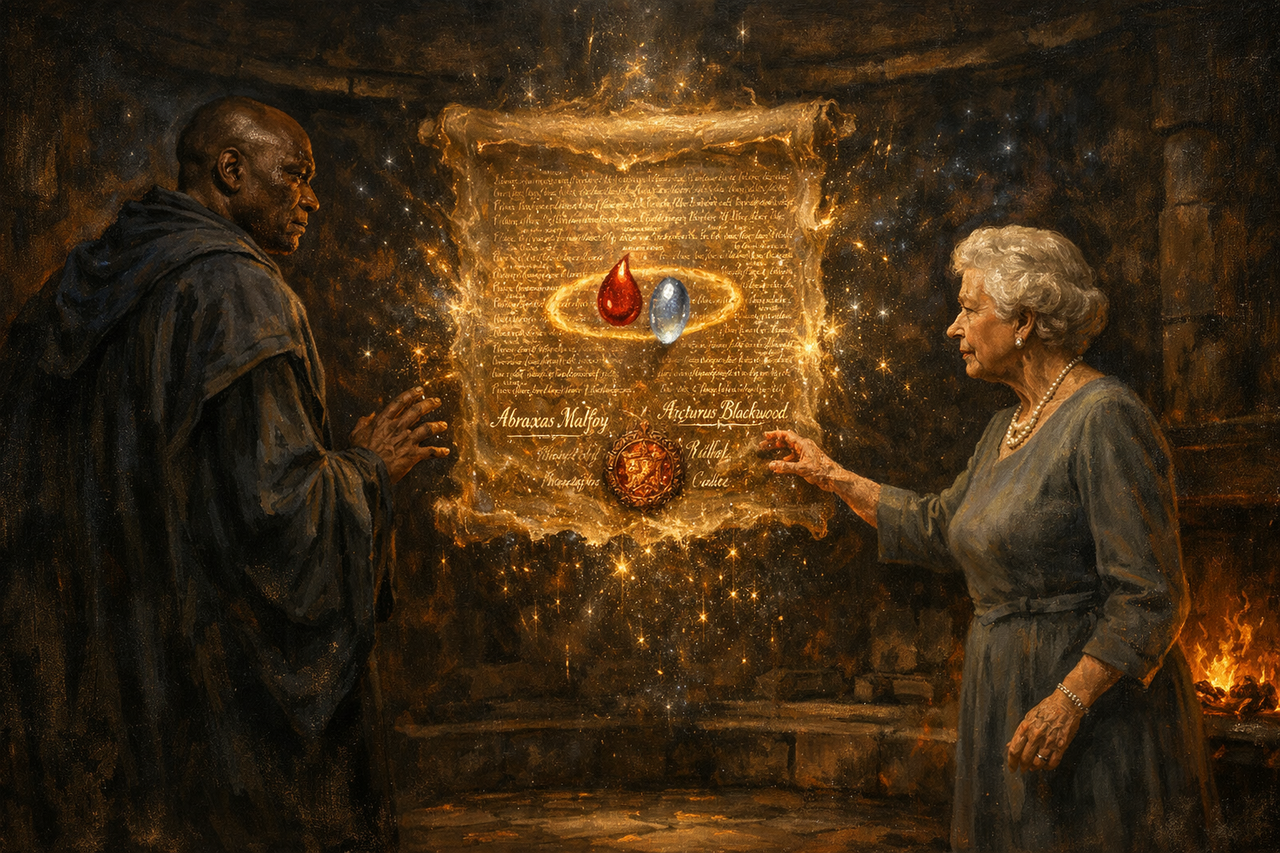
The Queen did not reach for a document. Instead, she lifted her hand, palm up. Above it, the air shimmered and bled colour. Light coalesced, thickened, and resolved into a three-dimensional, glowing tapestry of text and intricate, moving seals. It was a contract, but unlike any Gringotts deed or Ministry law. The parchment was spectral, woven from light and what looked like strands of liquid gold and crimson. The script was an archaic, flowing hand, but the magic it exuded was alive, pulsing with a slow, dormant power that now showed faint, awakening flickers. At its base were signatures not in ink, but in what appeared to be strokes of fire and frost, and beside them, two perfect, glowing drops of blood—one a brilliant scarlet, the other a deep, silvery blue—suspended in the air, slowly orbiting each other.
“This,” the Queen said, her voice resonating with the magic of the document, “is the Covenant of Sanguinis et Imperium. The Pact of Blood and Realm. Sealed in this chamber on the day of her birth, and bound with the blood of the last heir of a ancient magical house and the solemn vow of the Crown. It has lain dormant, protected by spells of forgetting and misdirection, for eighteen years.”
Kingsley stared, his breath caught in his chest. The magic was old, so old it tasted of iron and ozone in the back of his throat. The blood…
“Its primary enchantment was one of profound concealment,” the Queen continued, her eyes fixed on the orbiting drops. “To hide a child of inordinate magical and political significance. To bury a lineage so dangerous its mere existence threatened to ignite a war within a war. The magic altered memories, constructed false histories, and created a shield of mundane obscurity so complete that not even the child herself could perceive its edges.”
Hermione. The brilliant, muggle-born witch. The lie she had lived, the identity she clung to…
“The conditions for dormancy were twofold,” the Queen’s voice was mercilessly clear. “The continued safety of the realm, magical and mundane. And the age of majority of the child in question. The first condition has been met, albeit precariously, with the fall of the Dark Lord. The second…” She gestured, and a new line of script in the glowing contract flared with a sudden, fierce gold light. A date: September 19th. Hermione’s birthday. Just over a month ago. “The second condition has now been fulfilled. Upon her eighteenth birthday, the deepest geas of concealment began to unravel. The Pact is no longer dormant. It is… stirring. Awakening. And with it, all its secondary clauses, its promises, and its penalties, now come into full, binding force.”
Kingsley found his voice, though it was rough. “Secondary clauses?”
The Queen’s gaze finally left the dazzling, terrible document and returned to him. In her eyes, he saw not malice, but a profound and weary resolve. The look of a person who has carried a devastating secret for decades and must now, finally, begin to unpack its consequences.
“The concealment, Minister Shacklebolt, was only ever the first step. The prelude. The Pact was not merely to hide her. It was to preserve her for something. For a role, an alliance, a destiny written in blood and magic long before she drew her first breath.” She closed her hand, and the magnificent, terrifying contract folded in on itself with a sound like a sigh, vanishing. “Her blood status, as your world terms it, is not what she believes. It never was. And the world she knows is about to fracture around that truth.”
The silence after the Queen’s pronouncement was absolute, broken only by the low hum of the chamber’s ancient wards and the crackle of the fire. Kingsley felt the weight of every one of his years, every battle scar, settle upon him. The brilliant, fierce, muggle-born girl he had watched over, whose parents’ empty smiles haunted him… it had all been a fiction. A masterfully constructed lie woven with magic so deep it had fooled the world, and most painfully, Hermione herself.
“Show me,” he said, his voice a low rumble. He set his teacup aside, the delicate china suddenly feeling absurd in his large, scarred hands. “All of it.”
The Queen gave a slow, grave nod. She did not summon the full contract again. Instead, she lifted both hands this time, fingers moving in a complex, subtle pattern that was more invocation than wandwork. The air between them shimmered, and a new image coalesced—not the legalistic text of the Pact, but a heraldic tapestry come to life. It was a family tree, but one that glowed with internal light, its branches not wood but threads of molten silver and gold.
At its base, rooted deep in the spectral ‘earth’, was a name that made Kingsley’s breath hitch: House of Blackwood.
The name was encircled by a crest that materialised beside it: a shield quartered. In the first quarter, a golden lion rampant on a crimson field—England. In the second, a silver harp on a deep blue field—Ireland. In the third, three gold fleurs-de-lis on a field of azure—France. In the fourth, a white cross on a red field—Savoy, for Italy. Overlaid upon the shield was a single, striking symbol: a serpent and a lioness, not fighting, but coiled together in a protective circle, a single, multifaceted gem held between them. The motto scrolled beneath in elegant Latin: ‘Sanguis Antiquus, Cor Novum’ — Ancient Blood, New Heart.
“The Blackwoods,” the Queen began, her voice taking on the cadence of a historian, or a mourner at a graveside. “A lineage not merely pure of blood, but potent in a unique and dangerous way. Their magic was always… integrative. They were diplomats, translators, alchemists of culture and power. For centuries, they served as the crucial bridge between the Muggle Crown and the Wizarding Aristocracy. They understood both worlds intimately, respected their laws, and navigated the treacherous waters between them. They were the secret keepers, the treaty-wrights, the ones who ensured that a witch-hunt never turned into a true war, that a magical accident could be explained away as natural phenomenon.”
As she spoke, names on the tree lit up in sequence, brief images flickering beside them: a stern-faced man in Elizabethan ruffs signing a parchment with a quill that dripped light; a woman in Regency gowns whispering to a figure that was half-Prince Regent, half-shadowy wizard; a Victorian gentleman with Hermione’s clever eyes standing between a young Queen Victoria and a scowling, elderly wizard who looked suspiciously like a portrait of Phineas Nigellus Black.
“Their power lay in their duality,” the Queen continued. “They married strategically, always strengthening ties across magical Europe and the British Isles. English steadfastness, Irish wild magic, French elegance in enchantment, Italian mastery of alchemy and art—it all flowed in their veins. They were considered the ultimate purebloods, not because they shunned Muggles, but because they could move among them without detection, influence them without magic, and protect the secret from within the very heart of non-magical power.”
Kingsley watched, mesmerised and horrified, as the tree climbed towards the present. The branches grew thinner, the lights fewer. “What happened to them?”
“The same thing that happens to any family that holds too much delicate power in times of great darkness,” the Queen said, a flicker of old pain in her eyes. “The rise of Grindelwald, and later, the purist ideology of Voldemort, made them targets. To the fanatics, the Blackwoods were the ultimate abomination: purebloods who embraced their role in the Muggle world, who saw no contradiction in serving the Crown. They were ‘blood traitors’ of the most profound kind. A systematic campaign of eradication began. It was quiet, at first. Accidents. Unexplained vanishings. Failed magic.”
A branch on the tree snuffed out, then another. The light dimmed.
“By the late 1970s,” the Queen’s voice dropped to a whisper, “only one direct line remained: Eleanor Blackwood, your Hermione’s grandmother.” A name glowed brightly: Eleanor Catherine Blackwood. An image formed of a beautiful, serious-faced woman with Hermione’s riotous curls tamed into an elegant chignon, her eyes the same warm amber. She wore robes that blended wizarding cut with royal style. “My second daughter.”
The words landed in the silent room with the force of a Bludger to the chest. Kingsley stared, his mind reeling, trying to fit the pieces together. Hermione’s grandmother. The Queen’s daughter.
“Eleanor fell in love with, and secretly married, a brilliant, kind-hearted wizard from a minor but respected French pureblood family, Étienne Laurent,” the Queen went on. The name Étienne Laurent appeared, linked to Eleanor’s by a bond of shimmering gold. “They had one daughter: Helen. Helen Jean Blackwood-Laurent.” Another image: a younger woman, smiling, her face a perfect blend of her parents, her magic almost visible as a joyful, golden aura around her. Hermione’s mother.
“To protect them from the growing threat, Eleanor and Étienne performed a radical act. They used ancient Blackwood magic—the very magic of integration and concealment—to hide in plain sight. They altered their own memories and magical signatures, becoming two harmless, non-magical dentists from London: Wendell and Monica Wilkins. They believed it was the only way to save their daughter, to let her grow up free from the target on their backs.”
Kingsley closed his eyes. The Wilkinses. The cheerful, oblivious dentists. They hadn’t been Muggles who had a magical child. They had been powerful witches and wizards who had made themselves Muggles to save her. The sacrifice was staggering.
“But the threat was too pervasive,” the Queen said, the sorrow now raw in her voice. “The purist factions learned of Helen’s existence. She was the last true heir of Blackwood, a prize beyond measure. To control her was to control the legacy, and to potentially claim a connection to the Crown itself. Eleanor came to me, desperate. We devised the final, desperate measure: the Pact.”
The tapestry shifted, zooming in on Helen’s name. From it, a single, brilliant line shot forth.
“Helen married a good man. A loving man. A Muggle-born wizard named Richard Granger.” The name Richard Granger appeared, but it pulsed with a strange, unstable light. “It was a love match, pure and simple. He knew nothing of her true heritage; she was simply Helen Wilkins to him, a fellow student with a mysterious past. But his blood… his Muggle-born status… it created a complication the purists could not abide. And it triggered the latent Blackwood family curse.”
“Curse?” Kingsley interjected, the word sharp.
The Queen’s expression turned grim. “A failsafe, woven into the Blackwood bloodline centuries ago to prevent the dilution or capture of their power. If the last direct heir married outside a sanctioned alliance—specifically, if they married someone without a pre-approved magical lineage—and produced a child, that child would become a beacon. Their magical core would ignite on their majority with a signature so unique, so potent, it would be detectable to any who knew how to look. It would mark them as the heir, and paint a target on them brighter than the sun.”
She let that sink in. Hermione. A beacon. Her incredible power, her voracious intellect… was it just her, or was it the Blackwood legacy manifesting?
“When Hermione was born,” the Queen whispered, “she was the most magical child the midwives had ever seen. And she was doomed. The curse was active. On her eighteenth birthday, she would light up the magical world for her enemies. Eleanor, my daughter, made the choice. With my blessing and the aid of the most loyal royal sorcerers, we enacted the Pact. We took six-month-old Hermione. We modified the memories of Richard and Helen Granger completely, building upon the false identity Eleanor had already created for herself. We made them believe they were Muggles, that their daughter was a Muggle-born witch, a miraculous accident. We placed the deepest, most powerful concealment charms upon Hermione herself, masking her true magical signature, suppressing the beacon of the curse. We hid her in the last place anyone would look for a pureblood scion: plain sight, as a celebrated ‘Muggle-born’ war heroine.”
The tapestry showed it all: the threads of memory magic wrapping around the names of Richard and Helen Granger, twisting them into Wendell and Monica Wilkins. A brilliant, blinding light around the name Hermione Jean Granger being slowly shrouded in layers of intricate, shadowy spellwork.
“Her true name,” the Queen said, and the script on the tapestry reformed, the letters burning with a gentle, undeniable truth, “recorded in the Covenant and in the secret genealogies of this chamber, is Hermione Jean Granger-Blackwood, Princess of the United Kingdom, Heiress of the Most Noble and Ancient House of Blackwood. She is my great-granddaughter. And she is a pureblood witch, not by ideology, but by the oldest magical lineage in this land.”
Kingsley sat back, the weight of the history crushing. The sheer scale of the lie. The loneliness Hermione had endured, the survivor’s guilt she carried for her ‘Muggles’ parents… it was all a constructed tragedy to save her from a worse one. She wasn’t who she thought she was. She was royalty, in both worlds. And she was cursed.
“The Pact’s concealment has been breaking down since her birthday,” the Queen said, pulling him from his thoughts. “The magic that made her ‘Muggle-born’ is unravelling. Soon, her true magical core will begin to emerge. And when it does, the beacon will shine. Every Death Eater still at large, every purist fanatic in Europe, will know the last Blackwood heir has come of age. They will come for her. For her power, for her blood, and for the connection to the Crown she represents.”
She leaned forward, the firelight casting deep shadows on her lined face. Her eyes were flinty.
“There is more.”
The words ‘There is more’ hung in the warded air, a promise of further devastation. Kingsley felt a cold knot tighten in his stomach, worse than any curse he’d ever faced. He had just absorbed the seismic truth of Hermione’s identity—a princess, a pureblood heir, a hidden scion carrying a deadly family curse. What ‘more’ could possibly exist that wouldn’t shatter the fragile understanding he was desperately trying to rebuild?
The Queen did not make him wait. With another fluid gesture, the shimmering tapestry of the Blackwood lineage dissolved. In its place, the full, terrifying text of the Covenant of Sanguinis et Imperium snapped back into being, larger and more detailed than before. The glowing script swirled, sections highlighting themselves as she spoke, not with a historian’s distance now, but with the firm, unyielding tone of a sovereign stating immutable law.
“The concealment was Phase One of the Pact,” she said, her finger tracing a line of fiery text that outlined the memory modifications and magical suppression. “A holding action. A desperate measure to get the heir to adulthood alive. But the architects of this Covenant—my grandfather, King George V, and Arcturus Blackwood, Hermione’s great-great-grandfather—were not merely survivalists. They were strategists. They looked beyond the immediate threat to the long-term preservation of the alliance between Crown and the Old Magical Families.”
The document shifted, a new section scrolling to the forefront. The heading alone made Kingsley’s blood run cold: Clausula Foederis Matrimonii — The Matrimonial Alliance Clause.
“The Blackwoods were the bridge,” the Queen continued, her voice devoid of inflection, as if reciting a grim weather report. “But a bridge requires anchors on both banks. On one side, the Crown. On the other…” She paused, and the text below the header illuminated, revealing two names, linked by elaborate, binding sigils. “The most powerful, politically entrenched, and magically potent pureblood family still standing after the Grindelwald wars: The House of Malfoy.”
Kingsley shot to his feet, the chair scraping harshly against the marble. “No.”
The word echoed in the chamber, a blunt refusal that seemed to offend the very magic in the stones. The Queen did not flinch. She merely looked up at him, her expression one of weary patience. “Sit down, Minister. You are not here to negotiate. You are here to be informed.”
The command in her voice was absolute, honed by seventy years of rule. It was the voice that had addressed nations. Slowly, muscles protesting, Kingsley sank back into the chair, feeling as if the leather were swallowing him whole.
“Abraxas Malfoy, Draco’s great-grandfather, was a man of voracious ambition but impeccable pragmatism,” she explained, as if discussing a trade agreement. “He saw the value in a formal, blood-sealed alliance with the Crown through the Blackwood line. It offered legitimacy, influence in the Muggle world of a kind no other wizarding family could dream of, and a hedge against the rising tide of populist darkness that would later become Voldemort. For the Crown and the Blackwoods, it offered the protection of the Malfoy name, their vast wealth, their political web within the Ministry, and most importantly, their ancient, formidable bloodline magic—a potential counter-charm to the Blackwood Curse, a way to stabilise the heir’s power once it emerged.”
The contract zoomed in on the signatures. Not the recent ones of Eleanor and the Queen, but older, darker strokes. Abraxas Malfoy and Arcturus Blackwood, and beside them, the seal of King George V as witness and binder. The date was 1927.
“The clause is simple, and ironclad,” the Queen stated. “Upon the activation of the Pact—that is, upon the eighteenth birthday of the last direct Blackwood heir—the betrothal between that heir and the current male heir of the Most Noble and Ancient House of Malfoy becomes immediately active and legally binding in the eyes of magical and royal law. It is a covenant of blood and magic, sworn on the power of both lines. To break it is not merely to insult a family. It is to destabilise the foundational magic of the Pact itself, potentially causing the concealment charms to fail catastrophically and instantly triggering the beacon of the Blackwood Curse.”
Kingsley’s mind was a riot of images. Hermione, with her fierce sense of justice and hard-won independence. Draco Malfoy, the sneering boy who had called her a Mudblood, whose family had served the Dark Lord. The idea of them bound together was grotesque. It was a betrayal of everything she was, everything she had fought for.
“You cannot be serious,” he ground out, fists clenched on his knees. “After everything her family—her true family—fought against. After everything she fought against. To hand her over to that family? Lucius Malfoy is a convicted Death Eater! His son—”
“His son is an eighteen-year-old boy who was tried and cleared by your own Ministry, who fought in the final battle, and who is, according to this Covenant, her destined partner,” the Queen interrupted, her tone cooling several degrees. “The sins of the father are not, in the eyes of this ancient magic, automatically visited upon the son. The Pact is about bloodlines, not personal animosity. The Malfoys have upheld their end. They have known of the betrothal since Draco’s birth. They have prepared for it, politically and magically. Narcissa Malfoy, in particular, has been… expectant.”
The thought of Narcissa Malfoy waiting for Hermione made Kingsley feel physically ill. “This is barbaric. It’s a relic! Hermione has a right to choose her own life, her own partner!”
“She has a right to live, Minister!” the Queen’s voice sharpened, cutting through his anger. For the first time, he saw a flash of the immense pressure she herself was under. “This is not a fairy-tale romance. This is geopolitics written in blood. The Malfoy alliance provides a shield. Their resources, their influence, their very name will deter half of those who would come for her the moment her true nature is revealed. Furthermore, the blending of the Malfoy and Blackwood magics is theorised to be the only thing that can safely channel and control the eruption of her inherited power, to quiet the beacon of the curse. This is not about sentiment. It is about survival. The survival of my great-granddaughter, and the stability of the delicate peace between our two worlds.”
She leaned forward, the firelight catching the pearls at her throat. “Do you think I wish this for her? A marriage of obligation to a boy from a family with such a stained history? She is my blood. Eleanor’s granddaughter. But I wear the Crown. And sometimes, the Crown must make choices that break a grandmother’s heart to save a queen’s heir.”
Kingsley stared into the fire, his mind racing for alternatives, for loopholes, for any way out. There were none. He knew the power of such old magic. It would be like trying to hold back the tide with a teaspoon.
“How do you expect this to work?” he asked, his voice hollow. “They despise each other. Or, at the very least, Hermione has every reason to despise him and everything he represents.”
A faint, almost imperceptible smile touched the Queen’s lips then, the first truly human expression he’d seen since the tea was poured. It was a smile of infinite sadness and a sliver of hope. “Young people,” she said softly, “have a remarkable capacity for surprise. They are not their parents. They have lived through a war neither Abraxas nor Arcturus could have imagined. Circumstances change. Hearts… adapt. My own marriage was not a story of love at first sight. It was a duty. But duty can grow into respect, and respect, over time, in shared trials, can become something far deeper.” She paused, her gaze distant. “They will have to find their own way. But they will have to find it together. The Pact allows for nothing else.”
She stood then, a clear signal that the audience was concluding. The magnificent, terrible contract folded in on itself once more and vanished. The hum of the chamber seemed to soften.
“You have been a faithful guardian, Kingsley Shacklebolt,” she said, using his first name for the first time. “My daughter trusted Albus Dumbledore, and he trusted you. For that, you have my gratitude. Your role is now more critical than ever. You must guide her through this revelation. You must be her anchor when her world turns upside down. And you must prepare her to meet her obligations, for the safety of all.”
Kingsley rose slowly, feeling a century older. The weight of the secret was now infinitely heavier, for it carried a future he knew would cause Hermione profound pain.
The Queen walked with him towards what appeared to be a solid wall. As they approached, a doorway shimmered into existence, outlining a plain oak door. “The liaison will return you to your office. The formal arrangements will begin immediately. The Malfoys have been notified of the Pact’s activation. An engagement announcement will be made within the fortnight.”
She placed a hand on the door handle, then turned back to him. Her eyes, so like Hermione’s in their intelligence, held a glimmer of something that was not regal, but purely personal. A longing.
“I have seen photographs, of course,” she murmured, almost to herself. “Read every article, every school report Albus sent. I watched her, from the absolute distance this Pact demanded, grow into the brave, brilliant young woman who helped win a war.” She met his gaze, and for a fleeting second, she was just a great-grandmother. “I cannot wait to finally meet my granddaughter.”
Before Kingsley could formulate any response, the Queen opened the door. On the other side was not the palace corridor he expected, but the familiar, book-lined walls of his own ministerial study. The transition was seamless.
He stumbled through, and the door shut behind him with a soft, final click. It vanished into the wood panelling, leaving no trace.
He was alone. The cheerful postcard from Sydney still lay on his desk. The sun had set; his office was dark. The ordinary sounds of the Ministry at night—the distant clank of the lift, the whisper of memos flying past his door—felt alien and trivial.
He walked to the window, looking out at the lights of London. Somewhere out there was Hermione Granger, soon to learn she was Hermione Granger-Blackwood, a princess, a pureblood, and the betrothed of Draco Malfoy.
Kingsley Shacklebolt, Minister for Magic, Guardian of the Blood, put his forehead against the cool glass and let out a long, slow breath that did nothing to ease the ache in his chest. The storm was about to begin.