
Chapter Text
The door to his quarters chimes at a late hour, interrupting Spock from the last of his acquisition requests. Tapping a button on his desk to permit entry to his caller, he is unsurprised to find that it is the captain, evidently having escaped from the bridge before the end of beta shift.
“Your leave doesn’t technically start until midnight, which means legally you still have to hang out with me,” Kirk says as he enters.
“That is not what it means,” Spock replies, but he sets aside his padd and stands from his desk. “I presume you come seeking a game of chess?”
“Or any sort of distraction, really,” Kirk says, shrugging. “I’m gonna be bored the next three days, with you gone. And you’re gonna be bored cooped up doing nothing in here.”
“Vulcans do not experience boredom—”
“Don’t even, I saw your face during that diplomatic summit—”
“And I will not be ‘doing nothing.’ The process requires a considerable amount of mental exertion.”
Kirk drops into a chair and regards Spock skeptically. “You’re definitely supposed to be resting. I heard what Bones said.”
Spock had hoped to commence his onboard leave without fanfare; he had, in fact, slipped his leave request in between two other reports of low relevance with the express intention of having Kirk ignore it. His plans were ruined by the appearance of Doctor McCoy on the bridge, who had loudly announced that Spock would be taking the next three days off.
McCoy should not have been on the bridge during beta shift. No one had sent for him, and no one was injured. On other starships where Spock has served, doctors tend to stay in sickbay, where they are meant to be; on the Enterprise, this is often not the case.
“The doctor is overstating the issue,” Spock says.
“He said you’re overworked,” Kirk says. He has a rueful air about him now. “You should have told me you were tired, Spock. You work harder than almost anyone on this ship—you’ve probably earned a year off.”
McCoy had been of the opinion that everyone should get a year off, preferably somewhere with warm sandy beaches. He had grumbled loudly about Vitamin D.
“I will not be taking a year,” Spock says. “Merely three days.”
“We could all probably stand to have a longer shore leave soon,” Kirk says musingly. “Have to get through this mission first, I suppose.”
And then the one after it. And then another. There will likely be no shore leave for the Enterprise for quite some time. Spock, however, refrains from pointing this out. He has been made aware that doing so is not good for crew morale.
“I guess I won’t be too bored,” Kirk adds. “I’m joining the away team to Sulafat II tomorrow.”
Spock stills. “We are not scheduled to arrive at Sulafat II for five point two days.”
“They moved us up,” Kirk said. “Sorry. Report came in after you left the bridge. We’re getting there tomorrow. And no,” he adds firmly, seeing the look on Spock’s face, “you are not delaying your leave to join us. McCoy would have my head. You’re getting your meditation retreat.”
Spock objects to the word retreat. “The Vulcan mind is not like the human one,” he reminds Kirk as he fetches the chessboard. “I am well able to join tomorrow’s mission.”
“Yeah, well, you’re not going to,” Kirk says firmly. “We’ll be fine, Spock. You can rest.” He is using his blue eyes to make his point. Much has been made in literature of human eyes and their convincing affects; Spock did not assume these descriptions were quite so literal until he met Kirk, whose expressiveness puts every novel to shame.
However, this might simply be a side effect of the fact that his eyes are so very blue. It is a color not found in nature in Vulcan. Until meeting him, Spock had never seen its like.
“Very well,” he says. He begins to set up the board. “Though I remind you that I will not be remaining idle. The kae’tow-kath is a strenuous mental exercise.”
“I can’t think of a simple analog,” Kirk admits, sitting up to help set the pieces. “Something that wears you out but gets you rested at the same time.”
“It is less like a body gaining rest, and more like a system gaining order, Captain,” Spock says. He places his pawns in a neat row as he speaks. “If I may offer a metaphor, I have heard it likened to alphabetizing a shelf of books that have been disordered in some way.”
“Except the shelf being alphabetized is your brain.”
“It is not my brain. It is the consciousness I experience as a result of the electrical impulses of my brain.”
Kirk rolls his eyes. “You first,” he says, nodding to the board. Spock decides to open the game with his knight. “How does a mind get un-alphabetized?”
“How does a library? Any working system experiences disorder; this is true even of Vulcans, who have unparalleled mental discipline. Occasionally we must cease activity and tend to ourselves.”
“Routine maintenance,” Jim says, nodding. “All right. I think I just can’t quite…picture it. Like, what’s actually happening in your head.”
“This is typical of the psi-null. It is difficult to imagine a sense you do not have.”
Kirk absorbs this and visibly decides that it must be something very Vulcan and therefore beyond his purview. “Sure,” he says. He squints at the board and then does something rash with a rook. “Like those heat-seeking fish.”
They had not technically been fish. Spock knows that Kirk knows this, so he refrains from pointing it out, even though the scientist in him sighs. Regardless, the creatures in question did indeed possess an organ in the throat exclusively for detecting infrared waves. This governed much of their hunting patterns.
This also meant that they disproportionately attacked Spock, as his average body temperature is higher than that of his human crewmates. He suffered the indignity of several bites and a near-drowning before he was removed from the landing party to Deneb XI. Kirk thought it was funny, once he was certain Spock was out of danger. “That is one example,” is all Spock says.
“I guess I can’t believe you’re going to sit in one spot for three days,” Kirk says. “I’d be bouncing off the walls.”
“It will only make sense to you if you cease thinking of it as a passive activity,” Spock says. He moves a pawn in the hopes of tempting Kirk to take it. “I am not only going to be sitting.”
“Well, it’s a damn shame,” Kirk says, ignoring the pawn and in favor of moving his rook again. “Using your extra-special longer leave on something so mundane.”
Spock gives up trying to explain the significance to him. “And how would you make use of the time?”
“That depends,” Kirk says, stretching. “If it’s shore leave, then I like to eat a lot of food, swim in a warm body of water, and get laid.” He grins openly. Spock, knowing that a reaction is all the captain desires, does not give it to him. “It’s been too long,” Kirk adds, still goading. “The equipment’s getting rusty.”
“If you are discovering iron oxides in your penis, you should inform the doctor,” Spock says flatly, which makes Kirk burst out laughing. “Especially as we have no shore leave scheduled in the near future.”
“Don’t worry about it, Spock,” Kirk says, still chuckling. “I’ll live. Somehow.”
The idea that Kirk would die without sexual contact is a ludicrous one. He is not Vulcan. Spock refrains from pointing this out. “And when your leave is taken aboard the ship?” he inquires instead. “What is your habit then?”
“Lack of habit,” Kirk admits. “Unstructured time. Letting myself rove around with no schedule. I read more. Take naps. Maybe I drink more than I would otherwise.” He shrugs. “It’s different. It’s difficult to not be on.”
The word is non-descriptive, but Spock knows what he means. Even while ostensibly off-duty, a senior officer carries an awareness of the ship that is not easy to suppress. It is nearly impossible to utterly relax.
This is why Spock has not managed this deeper meditation in so long. There is even a chance that he will be unable to achieve it—but Spock is unable to delay until whenever the next shore leave may be.
It is not, as he as intimated to the captain, routine maintenance.
There has been a disruption to his mental systems.
He does not know its cause or cure. He does not know from whence, or why, the disruption came. He does not know if it will worsen or ease on its own. Quite simply, all is not well within Spock’s head, and he intends to find out why.
The trouble presented most obviously after his near-drowning on Deneb XI. He had awoken on a biobed, spitting brackish seawater, to find McCoy looming over him with a whirring medscanner. “What in the double-damn hell is wrong with your hormone levels, Commander?” he asked, and Spock, blinking up at him through wet eyelashes, had not known how to respond. That was eight point two days ago.
“Check,” Kirk says. They have passed several moves in silence.
Spock moves a knight. Kirk scowls at him.
McCoy was perturbed to find that Spock had been experiencing symptoms of sleep loss and lack of appetite without telling him. He fretted and tutted and ran a full health panel, despite Spock’s protests. The results came back as Spock expected: something is amiss, but its origin is not in his body. It lies in his mind. The body simply feels the effects.
Spock had known something was wrong. As it had not yet interfered with his ability to work, he had resolved to ignore it. McCoy’s intervention, however, forced his hand.
“Check.”
Kirk whistles. He studies the board. “You’ll have me in three, I think. Play it out anyway?”
“If you are not opposed.”
“My death throes.” Jim grins and moves his king by sliding it sideways with two fingers. He does not look like he is dying. He looks alive and at ease. He looks like the cadet that Spock met in an academy hall, brash and bright. He does not look like he is dying.
Spock moves. Kirk moves. Then— “Checkmate.”
“Damn.” Kirk knocks his king over. “You’ve got me. Another?”
“I ought to rest,” Spock says. “I intend to spend more hours asleep than usual ahead of my meditation.”
Kirk slouches back in his chair, frowning. “Are you’re certain you’re not sick? This all sounds kind of serious.”
“That is not my intention. I am certain it will not come a surprise to you that Vulcans are as regimented about their leisure as they are their work.”
His gambit is successful: Kirk’s expression clears and he laughs, shaking his head fondly. “Now you’ve got me thinking about Vulcans trying to play games,” he says. “Being eminently logical about Go Fish, or poker.”
There are Vulcans who have substantially improved the holdings of their clan’s coffers by taking part in a few carefully-selected poker games on the galactic circuit. Spock decides not to mention this. “You have seen me play chess,” he says.
“Yeah, and I know you’re not a stickler about the rankings only because you don’t want the rest of us to feel bad.” Spock says nothing, and Kirk laughs at him some more. “All right, I’ll get out of your hair.” He is not in Spock’s hair. “I’ll send you a report about Sulafat II for you to peruse when you wake up.” Coming out of meditation is not the same as ‘waking up.’ “Dinner tomorrow?”
“Perhaps,” Spock says.
Kirk grips his shoulder for a moment. He does this sometimes. It is a form of human camaraderie. “Goodnight, Mr. Spock,” he says, and the honorific on his tongue sounds mocking. Spock does not know how he manages to make even regulation bow to his good humor. “Enjoy your weekend.”
“It is not a weekend,” Spock says.
Kirk tips his head. “It’s basically a weekend.”
“That would rely upon the concept of a ‘week,’ which we do not have on this ship—”
“Uh, yeah we do, people say ‘week’ all the time—”
“—due to the fact that it is predicated on a Terran calendar that is no longer the standard—”
“It may not be the diplomatic standard, but trust me, households on Terra are still using it—”
“—to say nothing of the fact that I am not taking this time for needless indulgent relaxation—”
“Okay, wow, rest is literally a requirement for all living beings, Spock—”
“—instead engaged in a deep meditative state to restore my mental and physical function—”
“Which is exactly what rest and relaxation is for—”
“Goodnight, Captain,” Spock says, standing.
“All right, all right, I’m going!” One final insouciant smile. “Otherwise I’ll keep you here debating all through your weekend.”
Spock closes his eyes so that he will not do anything so insubordinate as sigh. He hears Kirk chuckling as he heads for the door.
As soon as he is gone, Spock sets about returning his room to tonic. Objects seem to migrate whenever Kirk is around; he fidgets, he prods at Spock’s belongings, he ends up fiddling with some memento or another nearly every time he spends more than five minutes in the room. Spock does not mind this. He can restore order. A smooth black stone, relic of a volcanic planet halfway between Earth and Vulcan-that-was, is warmer for having received the captain’s attention. Spock did not even see him pick it up. He sets it on the ledge behind his desk and then clears away the chessboard.
It is not a weekend. The ship does not run on seven-day units, and there is no formal system of rest for two of those seven days—this, Spock understands, is what a human means by weekend. Life aboard a ship does not permit that sort of schedule.
However, no one—not even a Vulcan—can be kept on duty indefinitely, and deep space missions often travel long spans of time without finding suitable planets for shore leave. Therefore, there is a staggered system of off-duty time allotted to each crew member, calculated by the quartermaster’s office to best align with each species’ physiological requirements and cultural expectations. Depending on rank, each crewmember is allotted one “day off” every five to seven days.
Spock takes one complete day of rest for every thirteen spent on duty, which is what he is accustomed to.
In truth, Spock would not be taking this longer rest if it were not imperative. If he can be said to dislike anything, he dislikes being off-duty when the ship is active. He likes it even less now, knowing that he will not be able to aid the mission to Sulafat II.
Kaiidth. All is not well within his mind, and he must find out why.
★
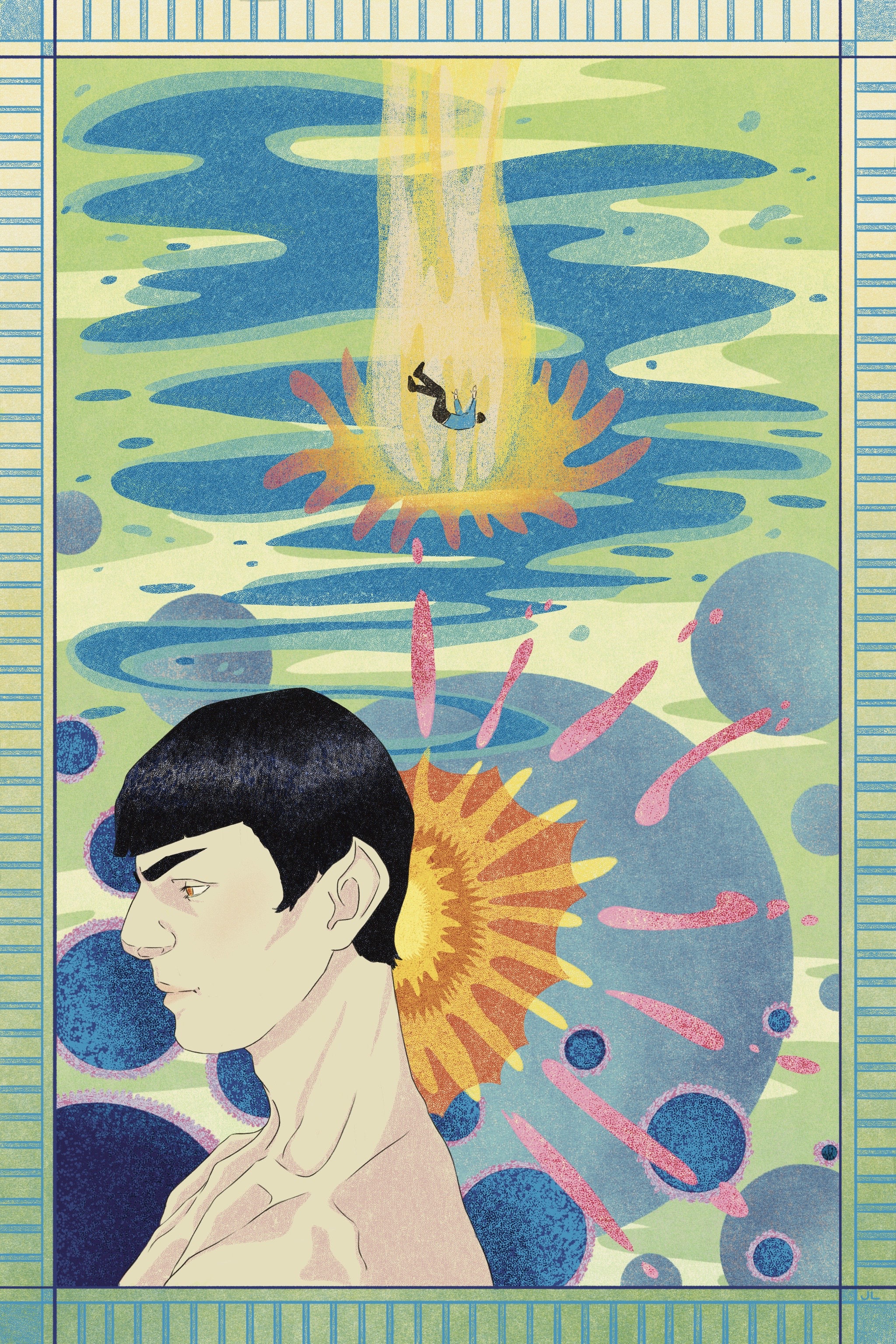
In the morning, Spock wakes later than usual and rises immediately to don his meditation robe. He increases the temperature of his room and washes his face in a beaten metal bowl. He lights his incense. Lastly, he sets a small timer that will chime once eight hours have elapsed.
The meditation that he undertakes nightly is light, almost entirely for the maintenance of the mind, rather like tidying a room. The meditation he intends to practice for the next three days is almost akin to the healing trance: it is far deeper; it will last far longer; it will restore his body and mind to their most optimal states; it will take a tremendous amount of energy. Spock will meditate all day, fasting until a large evening meal, and then sleep for 46% longer each night than is average.
It is rare for a Vulcan to have the time, space, and security to undergo this endeavor. Spock has not managed it since well before he joined this ship as first officer.
He kneels on a simple mat, rests his fingertips together, and closes his eyes.
In the earlier stages of their educations, Vulcan children are taught a variety of techniques for calming the mind. Some count down from incredibly high numbers, or repeat a simple mantra. As a child, Spock was in the habit of picturing himself stepping backwards down a long staircase in the dark, going slowly. Imagining such a cautious, atypical motion always focused him entirely. He feels no shame in utilizing the trick now. There is no need to struggle into stillness.
He steps backwards.
He sinks.
The ship lifts away from him like ink in water.
His internal clock is muted. His sense of his body is slightly faded. Spock works in his mindspace, descending steadily through the precepts he learned in childhood, for an indeterminate amount of time before he notices something…unusual.
His autonomous systems, his hormones—they are reacting to a presence in his mind whose origin he does not know.
It does not feel foreign. It does not feel harmful.
It is a light like a candle in the back of his mind. That small; that warm. It seems to have a physical placement at the base of his skull—he is aware of his own head, its boundaries, the way his telepathic senses roll further in and further out like waves on the seashore—but it also seems smeared across the mental space that he understands as his sense of self: memories, tenets, bonds. It glimmers there like spilled gold leaf. Like a crack of light under a door.
Spock does not know what this is.
In the deep passivity of meditation, he is not capable of feeling alarmed or even curious. The light simply exists, as he exists. The light lives within him, part of him.
He directs his attention to it. Prickles race up his arms; he feels them only dimly. He curls his sense of self around this light. He bids it open, like a music box.
There is a sudden jarring tug, like being hooked underneath the jaw, and suddenly Spock is falling.