
Work Text:
Surprise Me
1. Taco Bell
🔔
Eddie barely gets his boots off.
He’s sitting on the couch — has been sitting on the couch for somewhere between three minutes and twenty, the math is not currently available to him — with one boot in his hand and the other still on his foot, and he is, in the lowest part of his brain, conducting an argument about a shower.
The argument is this: he has been awake for almost twenty-four hours. He smells like smoke; on their last call they pulled a guy out of a sedan on the 405 that he is not going to think about in detail. He should, by every reasonable standard, get in the shower. He should stand under it for ten minutes and let it do what showers do.
The counter-argument is that the shower is down the hall.
He thinks about baby wipes.
He thinks about it for a moment, seriously. Baby wipes. He could, in theory, sit here on the couch, do a tactical wipe-down, kill the worst of it, and go directly to bed and deal with the rest in the morning. It’s not the worst plan he’s had in his life. He’s had worse plans this week, even.
Then he thinks about getting into his actual bed after a baby-wipe pass and a twenty-four-hour shift, and he thinks about the sheets, the sheets that Buck washes the way Buck does most things, with attention and slightly too much fabric softener, the sheets that smell like the lavender stuff Buck started buying last spring and never explained — and he thinks: no, you can’t get into those sheets like this. You can’t do that to those sheets.
He pulls off the second boot.
The boot drops sideways onto the floor and he leaves it there. He’ll pick it up later. Probably.
Then his stomach makes a noise that is, frankly, embarrassing.
* * * * *
He realizes that he hasn’t eaten since the gas station coffee and a granola bar at four in the morning, that the granola bar was approximately the size of a credit card, and that the part of his body responsible for keeping him alive is now placing him on a kind of formal notice about it.
He gets out his phone.
The phone is, he discovers, on three percent. This is — Eddie thinks of himself as a man who keeps his phone charged. Eddie is a man who, in most situations, keeps his phone charged. This is what twenty-four hours does to a man’s basic systems. He plugs the phone into the charger by the side table and haphazardly leans over to text Buck.
Eddie: home. alive. bored and dying of hunger
The reply comes back fast. Buck’s been on shift too — he got to go in later today, volunteered for some program at one of the colleges nearby and should be done about now. Which means Buck is at the level of a person and Eddie is currently at the level of an animal.
Buck: what u want
Eddie looks at the phone.
He looks at it the way you look at a small printed menu when the waiter is standing over you. He cannot, currently, make a decision. He cannot, currently, even read the words what u want with the appropriate level of comprehension. His brain is doing the thing his brain does, in this exact zone of tired, where the question what do you want to eat presents itself as roughly equivalent to please solve this calculus problem and also tell me what year it is.
Eddie: surprise me ♥️
The three dots come up. They stay there for a second longer than three dots usually stay. Eddie watches them, in his peripheral, the way you watch a kettle.
Buck: 👍
That’s all. Just the thumb. Eddie puts the phone face-down on the side table and lets his head fall back against the couch.
* * * * *
Christopher is in his room.
Eddie can hear him in there before he sees him — the distinct gunfire of whatever Christopher is currently playing, the specific tinny audio of a teenager playing a game with the volume just slightly louder than the rest of the household has agreed is acceptable. Eddie makes it as far as the doorway and leans against the frame.
“Hey.”
Christopher does not turn around. Christopher is sixteen now, which means Christopher has, in the last calendar year, developed the posture of a person whose center of gravity lives entirely in his hands. He is hunched. His thumbs are doing something complicated. There is, on his head, a pair of headphones Buck got Chris, with the stipulation that one ear remain tilted off so he could hear Buck or Eddie.
“Hey, Dad.”
“You uh, winning your game, Mijo ?” Eddie asks with a curious tone, not too sure what game his son is playing.
“Mm-hm.” Is all Christopher gives him.
“Okaaaay.” Eddie whistles.
“Buck on his way home?”
“Yeah.”
“Okay, cool.”
Eddie watches him play for another second. In the last year he’s given up on the idea that Christopher is going to make conversation with him in the middle of a game, and he has made an uneasy peace with this. Christopher loves him. Christopher will, in twenty minutes, look up from whatever this is and be a person again. The interim is just the interim.
He pushes off the doorframe.
“Buck’s bringing home dinner.”
“What is it?”
“I don’t know yet. I told him to surprise me.”
That earns him, finally, a flicker. Christopher’s head turns a quarter inch. His thumbs do not stop moving and his face is doing a thing that Eddie can’t fully see because Eddie is mostly behind him, but the corner of his mouth is going up, and Eddie does not — he does not, today, have the energy to interrogate his son’s private smiles. He accepts defeat and goes back to the couch.
He lies down on the couch.
He lies down on the couch in his uniform pants and a t-shirt that he has decided, in the absence of a shower, counts as clean enough for couch purposes, and he closes his eyes and listens to the gunfire and the ambient sounds of his house. The fridge is humming. A dog is barking somewhere down the block. He thinks, vaguely, about Buck.
The front door opens.
* * * * *
The smell hits him before the door fully closes.
Taco Bell. The specific Taco Bell smell — the warm tortilla, the melted cheese, the small unique edge of the Nacho Fry seasoning — and Eddie’s stomach makes its noise again, louder this time, more aggrieved.
“Hey, big guy.” Eddie says with a smirk.
The phrase, big guy, something Eddie started saying about a day or so after they made it all official, always makes Buck blush and turns his birthmark a shade darker.
Buck is in the entryway. Eddie can hear him — the keys in the bowl, the slight scuff of his shoes coming off, the rustle of the bags. Buck is, even after a shift, cheerful. Buck is in some sense, permanently cheerful. To Eddie, Buck enters rooms the way some people enter parties.
“Hi babe.” Buck says as walks past the couch with two bags in one hand and a large Baja Blast in the other.
He pauses, leans down, kisses the top of Eddie’s head. He smells like sweat from his own work day and soap underneath it, the soft cedar thing Buck uses, and Eddie tilts his face into the kiss without opening his eyes.
“Christopher. Food.” Buck calls out.
“Is it Taco Bell?” Chris yells from his room.
“Yeah.”
“Yes.” Chris says from down the hall.
Christopher comes out of his room. He’s pulled his headphones off, has them around his neck now, and his eyes are the slightly glazed thing of a teenager who has been in another world for the last forty minutes and is, briefly, in this one. Buck hands him a bag. Christopher takes it. Christopher peers into it. Christopher’s face — and Eddie watches this from the couch, head turned just enough — does the involuntary smile of a boy who has been correctly anticipated.
“Quesadilla.” Christopher says as he breathes in the smell of melted cheese and warm tortilla.
“With extra nacho cheese on the side.” Buck says as he hands over the extra plastic tub of nacho cheese that may or may not be actual cheese.
“You’re the best.”
“Don’t tell your dad.” Buck says with a wink.
“Oh, he knows.” Eddie says lovingly. Cause he does know, Buck is the best.
Christopher disappears back into his room with the bag. The door shuts behind him, the gunfire resumes.
* * * * *
Eddie pushes himself up to a sitting position; he’s not about to eat on his back with his food on his stomach like he’s some sort of otter.
He does it slowly, the way you do when your back has, in the last twenty-four hours, decided to be a thing it wasn’t yesterday. Buck is in the kitchen now, doing — Eddie can see him through the pass-through — Buck is doing something that involves opening a cabinet and getting down a plate.
“Buck.” Eddie says, cocking his eyebrow.
“Yeah.”
“Why do you have a plate.”
“Because I’m gonna plate this for you.”
“It’s Taco Bell.”
“Yeah, and you’ve been on shift for twenty-four hours, and you’re gonna eat off a plate like a person.”
Eddie does not, in fact, have the energy to argue this. He watches Buck plate his food at the counter. He watches Buck unwrap — and at this point, Eddie’s brain begins to come online, just barely, just enough to clock — a chicken quesadilla, a Doritos beef taco and a large nacho fry. Buck arranges them on the plate with what is, frankly, more care than the food deserves. He carries the plate over.
He sets it down on the coffee table in front of Eddie.
Then he comes back from the kitchen with his own plate already loaded — two bean burritos and an enormous Baja Blast.
He drops onto the couch beside Eddie, the cushions huffing.
Eddie looks at the plate, picks up the quesadilla and takes a bite — a big one, an unembarrassed one, the kind of bite you take when you have not eaten in nineteen hours and you no longer care about table manners or being a person — and he closes his eyes against the back of the couch and chews.
“Mmm.”
“Yeah?”
“Mm.”
“Sauce?”
Buck, without waiting for an answer, leans forward and rummages in his bag and produces a handful of mild sauce packets and drops them on the plate next to the taco. He knows. He knows Eddie likes mild, will not touch the hot, will, on a slightly braver day, mess with the diablo as a stunt and regret it.
Eddie tears one open and squeezes it on the taco. He eats the taco. He eats it in three bites. The Doritos taco shell does the inevitable thing the shell does, which is shatter on the second bite and shed itself across his lap and the front of his shirt, and Eddie is too tired to care. He is too tired to do anything but eat.
Buck is eating beside him, working through his first bean burrito with the speed of a man on his own shift recovery, and at some point, without comment, he picks up the giant fountain cup and tilts the straw toward Eddie.
Eddie takes a sip.
Baja Blast. It’s a color no drink consumed by humans should be, but the carbonation and the sweet punch of it elevates Eddie’s serotonin levels and he suddenly doesn’t care about Yellow 5 and Blue 1.
“That hits the spot.”
Buck grins.
He doesn’t say anything. He just holds the cup for him for another second, lets Eddie take a second sip, and then sets the cup down on the coffee table between them.
* * * * *
Eddie eats the nacho fries.
He is eating because it is in front of him and because his body has informed him, in no uncertain terms, that he is going to eat all of it, but his eyelids are getting heavy and his hand is getting slower and at some point he sets the half-finished container of fries down on the coffee table and just leans back into the couch.
“You done?” Buck asks.
“Yeah.”
“Couch or bed?”
“Couch.” Eddie says, rubbing his eyes.
“Okay.”
Buck gets up. Buck gathers — Eddie watches it without lifting his head, just his eyes — Buck gathers the plates and wipes the coffee table with the green rag he keeps under the sink for exactly this purpose. He carries everything into the kitchen and Eddie hears the dishwasher open, hears it close, hears the faucet run for ten seconds, hears it stop.
Buck comes back.
In his hand, the throw blanket from the back of the couch — the soft one, the one that lives in their house specifically because Buck has opinions about throw blankets — and he shakes it out and lays it over Eddie. Then he sits down on the edge of the couch next to Eddie’s hip and looks at him.
“Hey.”
“Hi.”
“You did good today.”
“You don’t even know what I did today.”
“I know what twenty-four hours looks like on your face. You did good. And Chim told me about the accident on the 405.”
Eddie reaches up. He’s not sure if his hand is going to make it, in the literal sense, but it does — his palm finds Buck’s jaw, his thumb brushes the corner of Buck’s mouth. Buck turns his head into it.
“How’d you know what to get?”
“What?”
“The —” Eddie gestures, vaguely, at the coffee table, at the now-gone Taco Bell, at the plates Buck has already cleaned up. “The food. All of it.”
Buck shrugs.
“I just had a feeling.”
“You always have a feeling.”
“Lucky guess.”
“Mm.”
“Go to sleep.”
“Buck.”
“Go to sleep, Eds.”
Eddie’s eyes close.
He hears Buck get up, very quietly. He hears Buck go around the house doing the ritual Buck does when Eddie is sleeping on the couch — Eddie has been on the receiving end of this routine enough times to know it by sound now. The TV in the den going down two notches. The hall light coming on, then dimming. The check on Christopher’s door, the soft hey, headphones off when you sleep, Superman.
The last thing Eddie hears, before he goes, is Buck’s hand on the back of the couch, just resting there, near Eddie’s shoulder, not waking him up. Just being there.
He files it, dimly, somewhere in the back of his head — Buck knew, he just knew, he always knows — and then he is gone.
* * * * *
2.
Starbucks
☕️
The thing about being thirty-three years old at the dentist is that nobody in the dentist’s office cares that you are thirty-three years old at the dentist.
Eddie is a grown man. He has been to war. He has been a firefighter for almost a decade. He has, with his own hands, performed actions on the human body that would, if he is being honest with himself, make most dentists look up from their work in alarm. He has nothing to fear from a filling. He has explained this to himself, in the mirror, twice this morning, in two different rooms.
He is, nonetheless, in a mood.
“You’re in a mood,” Buck says.
Buck is driving. Buck is driving because Eddie is in a mood, and Buck, having clocked the mood about four minutes after Eddie woke up, made the small executive call that Eddie was not going to be driving this morning, and Eddie, having no good counter-argument, had handed over the keys without comment.
“I’m not in a mood.”
“You haven’t said a word for nine minutes.”
“That’s not a mood. That’s a baseline.”
“Eds.”
“What.”
“It’s a filling.”
“I am aware that it’s a filling, Buck.”
“It’s, like, twenty-five minutes.”
“Yes, Buck.”
“They give you the numbing stuff and it’s —”
“Buck.”
Buck makes a small okay sound and stops talking. He’s driving with one hand on the wheel and the other on the gearshift in the easy way Buck drives most things, and Eddie, who has been staring at the windshield for nine minutes, glances sideways at him.
Buck is not, despite all of it, smug.
He’s not even, exactly, amused. He’s just there, driving, letting Eddie be in his mood without making it a thing, and Eddie — Eddie, who knows what it costs Buck to not make a thing of things, because Buck is constitutionally a person who makes a thing of things — Eddie reaches across the console and puts his hand on Buck’s thigh.
Buck’s hand comes off the gearshift and goes on top of his.
He says nothing.
They pull into the strip-mall lot eleven minutes later.
* * * * *
“I can come in with you.”
“No.”
“Eds. I can come in.”
“Buck. It’s a filling. I’m not — they’re not putting me under. They’re not doing surgery. They are filling a molar.”
“Okay.”
“You don’t need to come in.”
“Okay.”
“You can wait here.”
“I’m gonna wait right here.”
Buck is, at this point, trying not to laugh. Eddie does not, currently, have the bandwidth to address it. He has his hand on the door handle and he is preparing himself, in the way he prepares himself for things he does not want to do, by very deliberately not preparing himself at all.
He gets out of the truck.
He gets two steps toward the building.
“Eddie.”
He turns.
Buck has rolled the passenger window down. Buck is leaning across the center console, one elbow on the open window, grinning at him.
“What.”
“Don’t worry about the drill.”
“Buck.”
“You usually don’t mind when I’m the one doing the drilling, Eds, you’ll be fine, just relax —”
“Buck.” Eddie says, trying to seethe, but he’s blushing instead.
“Make sure you open your mouth wide. Really wide. But that’s not usually a problem for you is it?”
“Why did I even bring you along?” Eddie says, shaking his head.
He gives Buck the finger over his shoulder. He hears Buck laugh from the cab of the truck, the one Eddie loves, and he carries that with him through the strip-mall door and the claustrophobic fluorescent waiting room and the “Mr. Diaz, the dentist will see you now” and all of the rest of it.
* * * * *
Forty-five minutes later he is walking back across the parking lot with the right side of his face on another planet.
It’s a successful filling. The dentist had been thorough. The hygienist had been kind. They had given him the standard packet of aftercare instructions, told him not to eat for an hour, told him not to chew on the right side for the rest of the day, and sent him out into the world. He has a piece of gauze in his cheek. He has the small numb tongue that feels, against his teeth, like a tongue that is not his.
He is in a worse mood than he was when he went in.
Eddie gets to the truck, opens the passenger door, and sits down.
He sees, before he sees Buck, a Starbucks cup in the cupholders, labeled Eddie, his grande iced hazelnut oatmilk shaken espresso with vanilla sweet cream cold foam. And next to it, balanced very carefully against the lip of the second cupholder, a parchment-wrapped thing with a thin white stick coming out of it.
A cake pop.
The birthday cake one. The pink one with the white drizzle and the sprinkles, the one that lives in the case at the front of every Starbucks at hip height because somebody, somewhere at corporate, figured out that no human being can resist them.
Eddie looks at it. He looks at the coffee, then the cake pop, then at Buck.
Buck is in the driver’s seat with his own coffee in his hand, looking back at him. Buck has, at this point, perfected the face he makes when he is doing a Buck thing; it’s a particular configuration that involves mild eyebrows and a mouth that is, deliberately, not smiling.
“How was it?” Buck says.
“They filled a tooth. Buck.”
“Mm-hm.”
“Is that a cake pop?”
“Yeah, Eds.”
“I just got a filling because you feed me things like that. ”
“Mm-hm.”
* * * * *
Eddie picks it up. He picks it up very slowly. He is aware, more than anyone, that he has just had a filling, that he has been told explicitly not to eat for an hour, that he is going to eat this cake pop anyway. It is — there is no defense for it. The cake pop is going to win.
He takes it out of the little paper bag and puts the cake pop in his mouth. He bites — gently, because the right side is a different country — and the bite goes wrong, because the right side is a different country, but he gets enough of it to taste the sugar, the dense moist cake, the delicious chemical pink of the icing, and his eyes close for a second.
“Mm.”
Buck is, in his peripheral, definitely smiling now.
“That good?”
“Mm-hm.”
He chews — entirely on the left side, which is awkward — and swallows. He picks up his coffee and takes a sip.
A small amount of coffee, cold and creamy, comes back out the right side of his mouth.
It dribbles. Down his chin. He feels it before he can do anything about it, before his numb right lip can do its job, and he makes an offended noise in his throat that is the closest thing to a goddammit he is currently capable of producing.
Buck leans across the console.
He doesn’t say anything. He brings his hand up — his thumb, just his thumb — and he wipes the dribble of coffee off Eddie’s chin with a practiced unhurried motion. Then, holding Eddie’s eyes the whole time, he brings his thumb to his own mouth, and he licks it clean.
Fucker.
Eddie stares at him.
“I just had a filling, Buck, you can’t —”
“I didn’t do anything, Eddie.”
“You know exactly what you’re doing.”
“I’m helping.”
“Buck —”
“Eat your cake pop, Eddie.”
He eats it slowly, on the left side, the way you eat a thing you are not supposed to be eating but are eating anyway. Buck drives them out of the parking lot and they go on to the next thing — the hardware store, Eddie thinks, vaguely, although the dentist has eaten enough of his morning that he is currently letting Buck navigate the day on his behalf — and Eddie sits in the passenger seat with the cake pop and the coffee and the small leftover unsteadiness of his right cheek, and he watches LA go by out the window.
“I’m just saying. That’s probably how you got the filling in the first place.”
“Buck.”
“Probably.”
“Buck.”
“I’m just gently observing.”
“Drive the truck, Evan.”
Buck drives the truck and Eddie turns away so Buck can’t see the pink of his cheeks. Eddie files this away. For later.
* * * * *
3.
Chipotle
🌯
Eddie does not, generally, like working out with Buck.
The official reason is that they have different programs. Eddie is on a four-day split he has been doing in various forms since the Army, the kind of program a man builds on a notepad in 2009 and revises maybe twice in fifteen years. Buck is on whatever Buck is on this week. Buck reads workout content the way other people read horoscopes — with enthusiasm and a complete lack of long-term commitment.
The unofficial reason is that Eddie does not, when Buck is in the room, get any meaningful work done.
This is a problem he has tried, on several occasions, to solve. He has tried headphones. He has tried positioning himself in the part of the gym where Buck is not. He has tried, once, going at a different hour than Buck so that he could just be a man at a gym, alone, with his program. None of it works. Buck, even at a polite distance, is the most distracting thing in any room he is in, and Eddie has, over the course of their relationship, come to a kind of grudging peace with it.
He is, currently, halfway through a set of dumbbell rows on the bench by the mirror.
He is also, currently, watching Buck do incline presses across the floor.
He has been watching Buck do incline presses for the last ten minutes. Buck is in the navy tank he has had since he was twenty-six, the one that is, in Eddie’s opinion, against Buck’s interests to keep wearing in public. The straps are doing the small inadequate thing they have been doing for years. The back of Buck’s shoulders, which Eddie has, in his life, put his mouth on perhaps a thousand times, is doing — the thing — the flex-and-release of muscle under skin sheened with sweat, and Eddie has, the last two times he attempted his row, set the dumbbell down without finishing the set.
This is a Saturday.
This is a Saturday on which he has the day off, and Buck has the day off, and Christopher is at Denny’s house for the afternoon doing — Eddie has not asked. Christopher will tell him in the car later or he will not. The point is, the house is empty and the day is theirs, and Eddie has chosen, of all the things they could be doing with this rare aligned freedom, to come to the gym, where he is being psychologically tortured by his own boyfriend who does not even know he is doing it.
Buck racks the bar.
He sits up on the bench. He swipes the back of his arm across his forehead in a way that is, in Eddie’s opinion, sexually irresponsible in a commercial setting. He catches Eddie’s eye in the mirror.
Buck grins.
Buck knows.
Buck, Eddie has long suspected, has known for years.
“Eds,” Buck calls, across the gym, at a volume that is not appropriate.
“What?”
“You’re not doing your set.”
“I am doing my set.”
“You haven’t moved in two minutes.”
“That’s between me and my rotator cuff.”
“Sure, Eds.”
Eddie picks up the dumbbell. He does his row. He does not, technically, finish his set. He puts the dumbbell down with the same controlled motion he has used since he was twenty, and he does not look at Buck for the next four minutes, which is the most discipline he can muster in the situation.
* * * * *
They leave the gym at quarter to one.
In the parking lot, Buck is — Buck is glowing. Drenched, really. He’s gone slightly pink across the chest and at the throat in the way Buck goes pink when his blood is up, and his curls are damp at the temples in a way that is doing absolutely nothing for Eddie’s blood pressure. He pops the tailgate, drops his gym bag, leans against the back of the truck like a man on a billboard. Eddie hates him. Not really.
“Lunch?”
“Mm.” Eddie grunts.
“You need protein, Eds. You barely worked out —”
“That was your fault.”
“How was that my fault?”
“You’re distracting.”
“Aw.” Buck says in that little voice that he knows irks Eddie.
“You know what I’m talking about, Buck.”
“You’re hangry,” Buck says, deeply serious, leaning his hip against the bumper with the patient air of a man preparing to land a joke. “You’re hangry, and you need to eat. You need protein, Eds. From — you know. From other sources. You can’t always just be swa—”
The gym towel hits him in the chest before he can finish.
Buck is laughing — and he knows he’s going to pay for that joke later in a way Buck is going to enjoy paying for it. The towel slides off the front of him and onto the asphalt. Buck does not bend to pick it up. Buck does not break eye contact.
“I’m just looking out for your gains, Eddie.” Buck continues, despite those baby cow eyes glaring at him.
“Get in the truck.” Eddie says through his teeth.
Buck gets in the truck, still laughing. Eddie picks up the towel, mutters something at it, and walks around to the passenger side. He climbs in and closes the door harder than he needs to. Buck, beside him, has not stopped grinning.
Buck pulls out of the lot. He puts on his sunglasses. He drives.
“Chipotle?”
“Sure,” Eddie agrees, with the final dignity of a man being driven to lunch by the architect of his disgrace.
* * * * *
It’s crowded.
It is the kind of Saturday-lunch Chipotle crowd that Eddie has not, frankly, had the patience for since his late twenties — the line wrapped around past the chip station, the high-schoolers in athletic shorts, the small irritated mom with three kids on different volume settings — and Buck, who has been in line at a Chipotle in this state of crowdedness more often than Eddie because Buck eats Chipotle at a frequency that is, in Eddie’s opinion, not sustainable as a lifestyle, takes one look at the line and says:
“Patio. Go grab us a seat. I’ll order.”
“Buck —”
“Patio, Eds.”
Eddie does not argue. Eddie’s patience for lines is, on a scale of one to ten, currently a two, and the patio is outside, which has been an underrated venue option in Eddie’s life for years. He goes through the side door to the patio.
He finds a two-top in the corner under an umbrella.
He sits down. He pulls his phone out. He puts it face-down on the table because that is, in his head, the small intentional move he has been making in the last few months — put the phone face-down, you are here with Buck. Buck taught him this without ever saying anything about it. Buck does it himself.
He waits.
He watches, through the window, Buck in line. Buck is on his phone. Buck is scrolling something. Buck looks up, sees Eddie watching him, and pulls his face into a comic expression — the don’t be weird face — and Eddie looks down at his hands and tries not to smile.
He fails.
He is, he registers, smiling at the patio table at his own boyfriend through a Chipotle window.
This is a thing his life is now.
* * * * *
Buck appears at the patio door five minutes later with a tray.
He has, balanced on the tray: two large bowls, a bag of chips, a tub of guac, a tub of corn salsa, two waters, two forks. He puts the tray down on the table with the unwavering grace he has for these maneuvers, slides into the seat across from Eddie, and starts unloading.
He puts Eddie’s bowl in front of Eddie first.
Eddie opens the foil top.
The bowl is — the bowl is exactly the bowl. Light white rice on the bottom — light, the way Eddie has been getting his Chipotle since 2019, the year he decided the rice was filler and stopped letting it run his bowl. Light black beans on top of the rice — light, because Eddie does not like the black beans to dominate, a preference he has, in fact, never articulated out loud, has only ever embodied by quietly removing beans from his bowl when there are too many, a thing Buck has, evidently, been watching.
Double steak.
Eddie blinks at it.
He has not, in his memory, ordered double steak in front of Buck. He has, on several occasions, looked at his bowl on the way home, and thought I should have done double steak, and not said anything about it. Buck has, apparently, been receiving these signals on a frequency Eddie didn’t know he was broadcasting on.
Extra fajita veggies. Romaine lettuce. A spoonful of guac.
No sour cream. No cheese. No pico, which Eddie has decided is a fluid and ought to be in a separate container if it is going to be on his food at all.
It is, ingredient for ingredient, the bowl Eddie would have built if Eddie had stood in line for fifteen minutes and built it himself.
Eddie looks up.
Buck is smiling. He is smiling without showing his teeth, which is a smile Buck has only deployed in front of Eddie a small number of times and which Eddie has not yet, fully, learned the meaning of.
“Eat your bowl, Eddie.”
“Buck —”
“You worked out for forty-five minutes and then ogled me for the other thirty. You need to eat.”
“Buck.”
“Eddie.”
Eddie eats his bowl.
* * * * *
He eats it slowly. The double steak is, in itself, devastating. The light rice is exactly the amount of rice he wants. The fajita veggies are, somehow, hot still, which means Buck timed the line in such a way that the food arrived at the table at the optimal temperature, which is the kind of detail Eddie does not, in this moment, want to think about too hard.
At some point Buck reaches across the table and tears open the bag of chips. He pulls out a chip. He scoops a reasonable amount of guac onto it. He leans across the table.
Eddie opens his mouth.
Buck feeds him the chip.
He does it the way you do a thing you have done a hundred times. His other hand is under the chip to catch the crumbs. He puts the chip in Eddie’s mouth and his thumb brushes Eddie’s lower lip on the way out and his eyes do not, in this moment, leave Eddie’s.
“Good?”
“Mm.”
“Mm-hm.”
Eddie chews.
He swallows.
He looks at Buck, who has gone back to his own bowl, and he thinks — for the first time, in clear words, the thought arrives — something is happening here.
It is not, yet, a fully-formed thought. It is just — Buck is doing a thing. Buck has been doing a thing. Buck is, in some way Eddie does not yet have language for, knowing things he should not be able to know.
Eddie sips his water.
* * * * *
They walk back to the car together.
Eddie has his to-go bag with the half of the bowl he could not finish, and Buck, who finished his entire bowl in nine minutes, is sipping the last of his water. The sun has come around behind the strip mall now and the parking lot is doing its midday LA shimmer.
“Eds.”
“Yeah.”
“You’re being weird.”
“I’m not being weird.”
“You’re being quiet.”
“I’m always quiet, Buck.”
“You’re being quieter.”
“I’m thinking.”
“About what?”
Eddie does not answer immediately. He opens the passenger door of the truck. He gets in. He waits for Buck to come around to the driver’s side, get in, close his door. Then he looks at him.
“Buck.”
“Yeah? ”
“Are you a mind reader?”
Buck snorts.
“What?”
“Are you, Buck, some kind of food fairy? Some kind of — I don’t know what to call it. A Mind reader?”
“Eds.”
“That is the only explanation I currently have.”
“I’m not a mind reader, Eddie.”
“Then how?”
“How what?”
“How did you order me a Chipotle down to the grain of rice without asking me a single question about it? You didn’t even ask what I wanted. You just ordered it.”
Buck looks at him. The small smile, the not-showing-teeth one, is back. He doesn’t say anything for a second. He puts the key in the ignition. He does not turn it.
“Lucky guess, Eds.”
“You said lucky guess about the Taco Bell.”
“And it was lucky then too.”
“Buck.”
“You need a shower.”
“That is not an answer to —”
“You smell like a gym, Eddie, you and I both need a shower. Together.”
“Buck.”
“Let’s go home, get clean, and we’ll see what other lucky guesses I have.”
Buck starts the truck.
He pulls out of the parking lot. Eddie watches him drive, watches the late-afternoon light come through the windshield onto Buck’s hands on the wheel, and he files the thought again.
Something is happening here.
The file, this time, gets its own label. He doesn’t know what to write on the label yet. But he gets out a pen, in his head, and he uncaps it.
* * * * *
4.
McDonald’s
🍟
The first problem is the key.
The key is the key Eddie has had for years. The key has, in that time, been put into the deadbolt of his front door something in the neighborhood of ten thousand times, and Eddie has never once had a meaningful failure with it. The key is reliable. The key is a sure thing.
The key is not, currently, going into the deadbolt.
“Buck.”
“Mm.”
“The key isn’t —”
“Lemme.”
“I can do it.”
“Eddie, I have watched you try to do it for two minutes.”
“Twenty seconds.”
“Two minutes.”
“Twenty seconds, Buck.”
Buck leans over his shoulder. Buck is — Buck is warm against his back, and Buck is laughing, the soft helpless laugh he does when he is six beers in and trying not to be obvious about it. Buck’s hand comes around Eddie’s waist on one side. Buck’s other hand comes around the other side, and Buck — slowly, with the careful focus of a man who is operating on backup systems — puts his hand over Eddie’s hand on the key, and turns.
The deadbolt clicks.
“There we go.” Buck slurs.
“That was not a two-hand job.”
“You know what is a two-hand job though…” Buck whispers into Eddie’s ear.
Eddie gulps.
“Buck — inside. Now .” Eddie whines.
* * * * *
The door opens.
They make it into the house in the way Eddie has always thought drunk people make it into houses — through the doorframe at slightly the wrong angle, with one shoulder bumping the wall, with shoes that have been kicked off in the entryway in a configuration that is going to be a problem in the morning. The house is dark except for the lamp Buck always leaves on in the living room because, in Buck’s words, “houses shouldn’t be dark when their people get home.”
Eddie thinks about this — about Buck having opinions about lamps, about Buck leaving lamps on for him — and he turns around in the entryway and grabs Buck by the front of his shirt.
“Come here.”
“I’m already here, Eds.”
“Come here.”
Buck comes there.
Eddie kisses him.
It is — it is the kind of kiss two men share when they have been drinking for three hours and have spent the last thirty minutes in the back of an Uber not allowed to do anything about it. It is sloppy. It is not in any sense efficient. Eddie’s hands have found Buck’s hips and pulled, and Buck is laughing into his mouth — actually laughing, the Buck laugh, the one that comes up from his chest — and Eddie’s back hits the wall of the entryway with a thump that he is aware, in some peripheral part of his brain, is louder than it would be if he were sober.
“Eds —”
“Mm.”
“Eddie, baby, we have to —”
“No we don’t.”
“We — Eddie, we do — “
“Buck.”
“What?”
“French fries.”
Buck pulls back.
He pulls back the way you do when somebody, in the middle of a kiss, has just changed the subject in a way that affects the moral architecture of the entire evening. He looks at Eddie. Eddie looks at him.
“French fries, Buck.”
“Eds.”
“I need McDonald’s, Buck.”
“Eddie.”
“I need it.” Eddie says with his big brown baby cow eyes.
* * * * *
Buck does not, at this point, argue.
Buck has been with Eddie for long enough to know when Eddie is making a serious drunk request — the kind that, denied, will become an issue the man brings up the next morning over coffee — versus a theoretical drunk request. This is the serious kind. Buck reaches into his back pocket, pulls out his phone, and pushes Eddie with his free hand backward across the living room toward the couch.
Eddie goes backward.
Eddie goes backward over the back of the couch — his calves hit the cushion edge, and he, in the absence of a counter-strategy, goes over — and lands sideways on the cushions in a configuration that is, broadly, horizontal.
“Buck.”
“Sorry.”
“You pushed me.”
“You needed to sit down.”
“I wasn’t standing, Buck, I was leaning —”
“Eddie, you were not leaning, you were swaying —”
“I do not sway.”
“Mm-hm.”
Buck has his phone out. Eddie watches him — watches him through the small upside-down angle of his head on the cushion — thumb working at the Uber Eats app. Buck does it without asking Eddie a single question. Eddie has said French fries, and Buck has, in some part of his brain that is currently the only functioning part of either of their brains, made an executive decision.
Buck is, as he taps, also pulling off his own jacket. He gets it off with one arm. He gets it off with the other arm. The jacket lands on the armchair. He sits down on the couch — on the cushion Eddie’s head is on — and Eddie’s head, in the next motion, ends up on Buck’s thigh.
This is, Eddie decides, acceptable.
“Twenty minutes.”
“What?”
“Twenty minutes for the food.”
“Buck, can you — can you put on a thing?”
“What thing?”
“A thing. Like a movie. Like a — a movie.”
“You want a movie.”
“I want a movie, Buck, yes.”
“What movie?”
“I don’t know, Buck, you pick.”
* * * * *
The opening notes of Cars come through the soundbar at a volume Buck has been told, on more than one occasion, is the correct volume for movies and which Eddie, on principle, finds slightly too loud. The Pixar lamp appears on the screen. The lamp does its thing.
Eddie squints up at the TV.
“This is Cars.”
“You said pick.”
“Why?”
“Eddie, this movie is art.”
Eddie watches the opening montage. Eddie watches Lightning McQueen wake up, run through his pre-race routine, put on his Lightning-McQueen eye-black even though Lightning McQueen does not, in any practical sense, have eyes, and Eddie sits up halfway on Buck’s thigh, suddenly possessed.
“Buck.”
“Yeah.”
“How are these cars born?”
“What?”
“How are they born, Buck?”
“Eds —”
“Are they built? Buck. Are they built, in like, a — in a — who is building them?”
“Eddie.”
“There are no humans, Buck. There are no humans in this movie. So if there are no humans, who is building the cars?”
Buck is, on the cushion next to him, dying.
“Eds —”
“Are they born, Buck? Do cars give birth?”
“Eddie.”
“How does it come out, Buck?”
“Edmundo Diaz.”
“This is a real question.”
“It is not a real question.”
“And before the cars, Buck. What was there before? Wagons? Carriages? Was there an era of carriages before the cars, and the cars came along, and the — what happened to the carriages, Buck?”
“Oh my god.”
“Did the cars kill the carriages?”
“Eds —”
“Is this movie set after a genocide?”
“EDDIE.”
Buck has fully put his face in his hands. His shoulders are shaking. Eddie, who just heard his own argument, starts laughing now — and the two of them laugh until Eddie has to lie back down on Buck’s thigh because his stomach hurts.
* * * * *
The doorbell rings.
Eddie startles. Eddie startles in the specific way of a drunk man who has, in the last ten minutes, forgotten what part of the evening he is currently in, and Buck, laughing, kisses the top of his head and gets up off the couch.
“I’ll get it.”
“Buck.”
“What?”
“Hurry.”
“Eddie, the door is eight feet from us.”
“Hurry.”
Buck goes. Eddie hears the door open. Hears Buck say thanks, man in his polite voice, the slightly-too-loud-for-eleven-p.m. polite voice, and then the door closes and Buck is coming back with a brown paper bag with the Golden Arches on it.
Buck drops the bag on the coffee table.
“Ask, and you shall receive, my love.”
“Buck.” He says lovingly.
“I’m a miracle worker, Eddie.”
“You’re an enabler, Buck.”
“That too.”
Buck unloads the bag. Eddie watches him. Eddie watches him, and Eddie’s brain is, currently, on backup systems, but the part of his brain that has been clocking this for weeks — the file with the new label on it, the file that has its own pen — flickers awake in some quiet way as Buck pulls things out of the bag.
Buck pulls out his food; a Big Arch, two double cheeseburgers, a large fry and a Diet Coke.
Eddie side-eyes him.
“What? I’m hungry.” Buck says.
Then Buck pulls out, two plain cheeseburgers, a large fry, exactly 3 packets of BBQ sauce and a Frozen Coke.
“Buck.”
“Mm.”
“I said I wanted French fries. I did not say Frozen Coke or two plain cheeseburgers and BBQ sauce.”
“You didn’t.”
“How?”
“How what?”
“How — Buck. How?” Eddie says as he leans over, eyes glassy.
“Eat your cheeseburger, Eddie.”
Eddie eats his cheeseburger. He eats it on his side on the couch with his head on the armrest and Buck’s hand somewhere on his thigh. The cheeseburger is, in the way drunk fast food is, the best cheeseburger Eddie has eaten in months. It is plain, because, for some reason Buck cannot comprehend, Eddie has decided that the only correct cheeseburger configuration, is meat-cheese-bun; no garnish, no compromise. McDonald’s has, against the odds, delivered it correctly. He dips a corner of it in the BBQ sauce. He moans.
“Eds.”
“What?”
“You’re making — noises.”
“I’m eating, Buck.”
“You sound like —”
“Don’t.”
“Like you do when I —”
“Don’t, Buck.”
* * * * *
He watches Buck eat.
Buck is, currently, doing a thing. Buck is — Buck is opening his Big Arch — and Buck is, with the slow drunk concentration of a man performing a piece of personal artwork, putting French fries inside the burger.
Eddie sits up halfway.
“Buck?”
“Mm.”
“What are you doing?”
“It’s better this way.”
Eddie watches him do it. Buck closes the Big Arch. Buck takes a bite of the Big Arch — fries and all — and chews, and his face does the small ecstatic thing, and Eddie, on the couch, helpless, watches his ridiculous boyfriend eat a fry-stuffed cheeseburger at eleven thirty at night.
He reaches into Buck’s fry container.
“Hey.”
“What?”
“Eddie.”
“What, Buck?”
“You have your own fries.”
“Well, yours are better.”
Buck rolls his eyes. He rolls his eyes the deep slow way Buck rolls his eyes when he is performing exasperation, when Buck wants Eddie to know he is being put-upon and would also, if Eddie tried to leave the couch right now, hold Eddie down with his entire body. He pushes his fry container three inches closer to Eddie.
Eddie eats Buck’s fries.
* * * * *
Cars is, somewhere in the background, doing its thing. McQueen has —by now, Eddie has lost track of the plot. Eddie has eaten one and a half cheeseburgers, half a Frozen Coke, half of Buck’s fries, and his body has, in the last ten minutes, gone from engine running to engine idling to engine off.
He puts down what is left of the cheeseburger on the coffee table.
He turns sideways on the couch. He pushes Buck — gently, the way you push a person you love when you want them to be horizontal — and Buck, knowing exactly what is being asked of him, goes.
Buck stretches out on his back, length of the couch, head on the armrest. He pats his chest.
Eddie comes down.
He lays his head on Buck’s chest, his arm across Buck’s stomach, his legs tangled with Buck’s, and Buck’s hand comes up into his hair the way Buck’s hand always does, and the smell of Buck under the McDonald’s smell under the beer smell is — Buck. Just Buck. Cedar-soap-Buck. Eddie closes his eyes.
On screen, McQueen says something to Sally. Sally says something back. The music does its thing.
“Eds.” Buck prods.
“Mm.” Eddie says, heavy lidded.
“You good?”
“Mm-hm.” Is all Eddie says.
“You happy?”
“Mm-hm.”
“Eddie.”
“Mm.”
“I love you.”
“Mm. Love you too. So much.”
Buck’s hand slows in his hair.
Eddie’s breathing slows.
The McDonald’s bag sits on the coffee table. The Frozen Coke melts, very slowly, in its plastic cup. Cars keeps playing.
* * * * *
5.
Panda Express
🐼
Christopher has not come out of his room in two hours.
Eddie has, in those two hours, attempted: a casual knock with a hey, you good in there, which earned him yeah; a more pointed knock with a you hungry, which earned him nah; and finally, a knock with no question attached, just I’m here when you want to talk, which earned him absolutely nothing.
He has, since then, been in the kitchen, leaning against the counter, doing what he does when he is not sure what to do, which is to wait.
Eddie is good at waiting. Eddie knows that the move, in cases like this, is to be in the kitchen. Not knocking again. Not pushing. Just — present, in a known location, with the kitchen lights on and the dish towel folded on the handle of the oven and the sounds of a parent doing nothing in particular emanating outward in a way a teenager can hear from his room and decide to ignore or not ignore.
Christopher, at this moment, is ignoring.
A fight, probably. With Denny or with the kid from soccer or with the new one — Asher? Ashton? — that Christopher had been spending a lot of time with at school. Eddie does not yet know which one. Eddie will know when Christopher tells him.
His phone buzzes on the counter.
Buck’s name and photo lights up the screen.
“Hey.”
“Hey, Eds. Twenty out. Is everything okay — you sound off.”
“It’s Chris. He’s fine. But he came home like a thundercloud. Won’t come out of his room.”
“Asher or Denny?”
“Asher, probably.” Eddie says as he paces back and forth.
“He eat anything?”
“Granola bar.”
“Eddie.”
“I know.”
A beat. Eddie hears the engine on the other end, the indicator clicking. Buck has pulled over somewhere.
“Okay. On it.”
“Buck —”
“Trust the process. See you in a few. Love you.”
The line goes dead.
Eddie sets the phone face-down on the counter. He puts the dish towel on the handle of the oven straight. He goes back to leaning.
Buck is on it. Whatever it is.
* * * * *
Twenty-six minutes later the front door opens.
“Eds? Coming in, hands full.”
Eddie goes to the entryway. Buck is just inside the door, two plastic bags in one hand and a third hooked over his wrist, jacket still on. He sets the bags on the side table. He pulls off the jacket, hangs it, runs a hand through his hair, picks the bags back up.
“Hi.” Buck says as he leans in and gives Eddie a quick kiss.
“Hi.”Eddie says back, fully expecting a longer kiss later on.
“Still in his room?”
“Yeah.”
Buck nods and then heads down the hall, to Christopher’s room.
He has watched Buck handle Christopher in some form or another since Christopher was eight, and in the years since this man became, by his own quiet doing, Christopher’s other parent, Eddie has watched Buck handle him in ways Eddie does not always have the toolkit for. Buck has the off-angle, is how Eddie thinks about it. Buck can come at a problem from the side. Eddie comes at problems straight on because that’s how Eddie was raised and that’s how the Army taught him and that’s the only operational mode he knows.
Buck has the side door. Buck has had the side door for years.
Eddie carries the food into the dining room and waits.
He can’t make out the words from where he is, but he can hear the shape of it. Buck’s voice through Christopher’s door, low and warm. Buck’s voice not waiting for a reply. Buck’s voice doing the thing he does, which is just — talking. And Christopher doing what a teenager does — ignoring his parents.
Then Eddie hears, drifting down the hall in Buck’s sing-song register; “Guess I’ll just have to eat all these cream cheese rangoons by myself, then.”
That does it, the door opens. Finally.
Christopher walks into the dining room looking exactly the way he always looks when he has decided, against his will, to be part of the household again — expression flat, posture defensive in the I will participate but I am not happy about it register that has been Christopher’s resting state since he turned thirteen. He does not look at Eddie.
“Buck got Panda.”
“I can see that.” Chris says dryly.
Christopher slides into a chair and puts his head down on his arms.
The dining table, in itself, is notable. They do not, as a household, often eat at the dining table — they eat at the island, or on the couch, or wherever they happen to be — and Buck has, in the time it took to walk Christopher down the hall, set the dining table. Placemats. Napkins. Chopsticks for himself, a fork for Christopher, the beginner-style chopsticks for Eddie, the kind for people who have been politely told by their friends in college that their chopstick technique would be improved with the help of a rubber band.
Eddie does not ask why they are at the dining table.
He suspects he knows. The dining table is where they eat when one of them has decided this is going to be a meal, where Christopher cannot put his head down and disappear into his food. The dining table requires you to be a participant.
Christopher is in a hoodie with the hood up and his sleeves over his hands, picking at the edge of the napkin Buck folded for him.
Buck unpacks the bags.
Christopher’s comes out first. A two-item plate: double orange chicken — the real thing, chow mein, fried rice. And the cream cheese rangoons Buck has, by this point, already promised him through the door.
Christopher pulls the rangoons toward himself without a word. He picks one up. He takes a bite — a small one, the I’m not committed yet bite of a teenager who is, in fact, deeply committed — and the involuntary noise that comes out of him is the noise Eddie has been waiting to hear for two hours.
Eddie feels, in his chest, a thing.
He does not, in this moment, name it.
Buck’s bag comes out second. Double chicken teriyaki, brown rice, and an egg roll.
Then Eddie’s.
Eddie watches him pull out a two-item plate. Double chicken teriyaki, fried rice, and a bag of cream cheese rangoons — which, normally, is not how Eddie does it. The rangoons live in a separate category in Eddie’s head; a thing he earns, a small bribe to himself, the side he only orders when he gets the Panda Bowl so that the calorie math at the end of the meal looks less indefensible.
Tonight Buck has bypassed the math entirely.
He has put the teriyaki and the rangoons and the rice in front of Eddie like a man who has decided, on Eddie’s behalf, that the math is not the point tonight. It’s an executive decision. One Eddie is, in this moment, grateful for.
And stuffed inside of the bag , a smaller bag full — full, twenty packets at least — of sweet and sour sauce.
Eddie picks up the baggie.
“This is a lot of sweet and sour, Buck.”
“You like sweet and sour, Eddie.”
“I do like sweet and sour. But this is twenty packets.”
“It’s eighteen.”
“You counted.”
“I asked for more, Eds. The cashier put them in the baggie.”
Eddie sets the baggie on the table.
He looks at Buck. He looks at Christopher, who has perked up enough now to be watching this exchange with the small mild interest of a teenager who has, in the last few minutes, become a person again. He looks back at Buck.
He does not say anything.
He picks up his fork. He eats.
* * * * *
Christopher is, within about four minutes, a different boy. His shoulders come down. He pushes his hood off. He stops picking at the napkin and eats his orange chicken. He starts, in small uncertain pieces, talking.
Not about the fight. Not yet. About other things. About a video he saw. About a kid in his physics class. About — Eddie watches it happen — about, eventually, in the small sideways way sixteen-year-olds bring up the actual thing, Asher.
Eddie does not interject. Eddie has learned, in fifteen years, when to interject and when to let Buck handle a thing, and Buck is handling this thing. Buck is asking the right questions. Buck is making the right small noises. Buck is, at one point, refilling Christopher’s water glass without being asked.
Christopher talks for nine minutes.
He talks about — a fight, yes. A real one. The kind that has, in his words, messed everything up. Buck listens. Eddie listens. Christopher reaches the end of the story and stops, and the table is quiet, and Buck — Buck waits a beat — and says: “Yeah. That sucks, Superman. I’m sorry.”
That’s all.
He doesn’t try to fix it. He doesn’t offer advice. He just — sits with it, with Christopher, the way a parent sits with a kid who has just told a hard story, and Christopher nods, and goes back to his rangoons, and the air at the dining table is, somehow, completely different.
* * * * *
After a while, Christopher looks up.
He looks at Buck. He looks at Eddie. He looks at the table — at the cream cheese rangoons, at the orange chicken, at the chow mein, at the small ridiculous baggie of sweet and sour — and he says, mildly, without looking up:
“Buck.”
“Yeah.”
“You always know what to get us without asking.”
Buck’s eyes flick to Eddie’s.
It is — it is the smallest flick. Less than a second. But it is a flick. Eddie catches it. Eddie catches it and Christopher, who is sixteen, who is in many ways his father’s son, catches Eddie catching it, and the corner of Christopher’s mouth — Eddie can see it — does a small thing.
“I just have a feeling.”
Christopher goes back to his food.
Eddie does not.
* * * * *
Eddie sits at the dining table with his fork in his hand and Christopher’s words running through his head, and the last three weeks — the Taco Bell, the cake pop, the Chipotle, the McDonald’s, the Frozen Coke, the Frozen Coke — arrange themselves, in his head, the way a string of small lights arranges itself when somebody, somewhere, plugs in the cord.
Click.
Click.
Click.
Eddie sets his fork down.
Christopher, oblivious now, has moved on. Christopher is telling Buck about the new physics teacher. Christopher is showing Buck a thing on his phone. Christopher is, in the way of a teenager whose mood has fully returned, talking too fast and gesturing with his chopsticks, and Buck is laughing at the right moments and Eddie is watching it all from the other side of the table like a man watching a thing he has just been handed the key to.
He looks at Buck.
He’s going to ask. He’s going to ask tonight.
Not now. Not at the dining table. Not in front of his son. But tonight.
He picks his fork back up. He keeps eating. He does not say a word.
* * * * *
The fortune cookies come last.
They are, as always, the worst part of Panda — stale, the kind of stale they were stale before they were ever fresh — and Buck has, as always, an opinion about them. Buck believes in the cookies. Buck reads his fortune every time. Buck has, on three separate occasions, taped a Panda Express fortune to the fridge for no reason Eddie has been able to extract from him.
Buck cracks his open first. Reads it. Frowns.
“Mine’s bad.”
“What does it say?”
“It says patience is a virtue. That’s not a fortune, that’s a quote.”
Christopher, mouth full, says, “It’s still your fortune, Buck.”
Christopher cracks his open. He reads it. He smiles, a small actual smile, the first full one Eddie has seen from him all afternoon.
“What?”
“Good things take time.”
Eddie cracks his open.
He pulls the small slip of paper out of the broken cookie. He unfolds it. He reads it.
His mouth does — a thing.
Buck, across the table, “What?”
“Nothing.”
“Eds.”
“It’s nothing.”
“What does it say?”
“Buck.”
“Edmundo. What does it say?”
Eddie hands the slip across the table.
Buck reads it.
Buck’s whole face does — a thing. The slip of paper, in Buck’s hand, is white and small and creased in the middle where it was folded inside the cookie, and the small machine-printed line on it says, in tiny red serif type:
The one who loves you is closer than you think.
There is a long moment.
Christopher, from across the table, watching them both: “Oh, gross.”
“Christopher.”
“Are you guys gonna kiss now?”
“Mijo, eat your rangoon.”
Buck is laughing now — the small wet laugh he does when he’s trying not to make a thing of something, the slip of paper still in his hand, his eyes a little bright — and Eddie, who has just had three weeks of small things click into a single picture and is now also holding a fortune cookie slip that has decided to be a load-bearing piece of his evening, reaches across the table and takes Buck’s hand.
Buck folds the fortune up.
He puts it in his shirt pocket.
He keeps holding Eddie’s hand for the rest of dinner.
* * * * *
The ceiling fan is going.
Eddie has rolled off Buck and onto his back, and the two of them are now side by side, breathing the way you breathe after — the slow uneven recovery of two men who had not, in any organized sense, planned for the last half hour to go the way it had gone, but had let it. The room is dark except for the lamp on Eddie’s side of the bed, the one Buck calls the romance lamp in a tone of voice that does not, in fact, undermine its effectiveness. Eddie’s mouth tastes like Buck. His chest is sticky in two specific places. The sheet is halfway off the bed.
Buck, next to him, is doing the small breathless laugh he does after.
“Eds.”
“Mm.”
“You — Jesus, Eddie.”
“Mm-hm.”
“That was —”
“Mm-hm.”
Eddie does not, in this moment, have the language. The language is going to come back, in a few minutes, the way it always does, but for now his words are still somewhere behind his sternum and his hand is, of its own accord, resting on Buck’s stomach because that is, in the absence of a more sophisticated plan, where Eddie’s hand has decided to be.
He turns his head on the pillow.
Buck’s birthmark is few shades darker. It always goes that color when Buck has been worked over for a while, the small specific dark-pink Eddie has — in his life — put his mouth on more times than he can count. Buck’s hair is damp at the temples. There is a small wet patch at the corner of his mouth he has not yet wiped, and Eddie, looking at it, is going to have to think later about whether or not he has, in this moment, ever loved another human being more.
“Buck.”
“Mm.”
“Question.”
“Mm.”
“How do you do it?”
“Do what?”
“The food.”
Buck’s eyes are closed. He smiles without opening them. The smile is loose and unguarded and a little smug and Eddie watches it happen.
“Lucky guess.”
“You said lucky guess about the Taco Bell.”
“Sure.”
“And the McDonald’s. And the Chipotle, Buck, the Chipotle — light black beans, double steak, no pico, I have never said those words to you out loud in my entire life —”
“I just pay attention, Eds.”
“Mm.”
“That’s it. I pay attention. To my —” Buck waves a hand, vaguely, in the general direction of his own chest, “ — to my person.”
“Buck.”
“Mm.”
“Do you keep some kind of list?”
The chest under Eddie’s hand stops rising.
It’s a half-second, maybe less. Buck inhales again immediately, the way a man does when he has decided not to give a tell and is going to give one anyway, and Eddie — Eddie has spent the better part of nine years learning to read this specific man’s body, has spent the last hour with his hands and his mouth on most of it, has, with the technical precision of a captain doing a walk-around on his rig before shift — felt the breath stop.
He pushes himself up on one elbow.
“Oh.”
“Eds.”
“Oh my god, Buck.”
“Eddie.”
“Oh my god, you do keep a list.”
* * * * *
Buck has opened his eyes. He is, currently, looking at the ceiling fan in a way that suggests the ceiling fan has personally offended him, and Eddie, propped up on one elbow now and grinning at him in a way he is not making any attempt to control, watches him do it.
“Show me.”
“Eddie.”
“Show me.”
“It’s not a list, exactly.”
“What is it, exactly?”
“It’s a — it’s a note.”
“Then show me the note, Buck.”
Buck exhales, rolls over and reaches for the nightstand. He pulls his phone off the charger.
The screen lights his face from underneath as he thumbs through it — past the lock screen (a photo of Christopher from two summers ago, the three of them at the beach, where Christopher was still a sensible teenager and hadn’t discovered Roblox), he opens up Eddie’s contact.
“Don’t be weird about it.”
“Buck.”
“I mean it, Eddie.”
Eddie takes the phone.
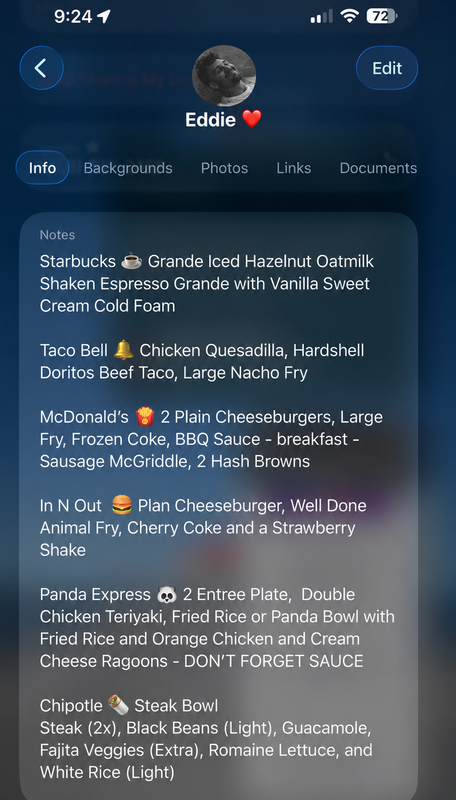
Eddie reads it.
He reads it once. He reads it twice. He reads it a third time, slower, his thumb scrolling carefully down the screen, his eyes catching on small things — the emojis Buck has typed in by hand, the parentheticals, the specific way Buck has written DON’T FORGET SAUCE in all-caps as if to himself, as if to remind himself in a moment of pressure not to make the mistake of forgetting. He reads things he has never said out loud. He reads things he is reasonably sure he has not actively thought about. He reads them and the small clean sentence in his head is;
Buck has been paying attention.
Buck has been paying attention to me. For years.
He sets the phone face-down on his bare chest.
He doesn’t say a word.
The ceiling fan does its thing. The lamp does its thing. Buck, beside him, has gone very still — not the I am giving a tell still of two minutes ago, but the actual still of a man bracing himself, the kind of still that has, somewhere in it, the small wound underneath. Too much, the wound says. You showed him and now he is being quiet and it was too much.
Eddie can read the wound from here. He has been reading it for years.
He picks the phone up again.
“Buck.”
“Mm.”
“How long have you had this list?”
“It’s a note.” Buck says with that smile.
“How long have you had the note?”
Buck looks up at Eddie, their eyes meet, Buck grips his gaze for a moment and then looks back up, timidly.
“A while.”
“How long is ‘a while’?”
“A few years.”
Eddie’s throat does the thing.
“It just —” Buck breathes out. “Eds. It wasn’t — at first it wasn’t anything, all right? It was — okay. Look. Sometimes if I didn’t want to cook at the station, I’d just go grab food, right?”
“Yeah.”
“I was making a list. Of everyone’s orders. So I wouldn’t have to ask. Bobby’s coffee. Hen’s bagel. Ravi’s non-negotiable Pepsi products only. Chim’s — everything, that man does not order food like a normal —”
“Buck.”
“I had everyone’s, Eds. It wasn’t weird. It was efficient.”
“Right.”
“And then one night you and me and Chris went to that — the Thai place on Vermont, the one Chris liked? And I was watching you eat, and I noticed that you weren’t touching the basil — you pushed it all to one side, like, surgically — and I went home and I — I just opened up the note I had for the station and I made you your own.”
He shrugs. He won’t quite look at Eddie.
“It wasn’t supposed to be a thing. I just — I kept noticing stuff. What you liked, what you didn’t. What you ordered when you were tired. What you ordered when you were happy. What you’d ordered last time and what you regretted. And after a while there was a lot of it, and it had its own — it had its own note. And by then —”
He stops.
“By then what?”
“By then I’d been keeping a separate file on you for like six months, Eds, and I had to sit down and have a conversation with myself about whether or not it was normal to be that — aware — of your best friend’s food preferences.”
Eddie waits.
Buck’s mouth does a small thing. He looks up.
“It wasn’t. Normal. So.”
A beat.
“So, eventually, I had a different kind of conversation with myself instead. And Maddie. And after making my own note of what was normal best friend behavior versus in love with your best friend behavior, I - uh, figured it out.”
Eddie’s throat gets that scratch again.
He sets the phone down on the nightstand. He turns. He puts his hand on the side of Buck’s face — palm cupping the jaw, thumb at the corner of Buck’s mouth, the small wet patch he hadn’t wiped yet, and Eddie wipes it with the pad of his thumb without thinking. Buck’s eyes are wet at the edges. He’s flushed all the way down to his collarbone. He is, in the language Eddie has been learning for nine years and counting, bracing.
“Don’t make it a thing, Eds.”
“Evan. Listen to me.”
Buck closes his eyes for a second.
Eddie does not speak right away. He needs the second himself. He has been a man in his own body for thirty-three years, has been a man in this man’s bed for some part of those, has been seen by Evan Buckley in ways he has, at various points, found terrifying and, at others, found like a homecoming — but this is something else.
This is a note. On a phone. In a notes app. Built quietly, by hand, over years, in the small uncounted hours when Buck was sitting somewhere watching Eddie eat and putting things into the file without telling him about it. A note that contains the order Eddie picks at McDonald’s when he’s coming off a twenty-four. A note that knows about the sweet and sour.
Nobody, Eddie thinks, has ever in his life sat down and made a quiet record of him like that. Nobody has cared enough to write him down.
Buck has.
For years.
“Nobody,” Eddie says, very quietly, “has ever paid attention to me like this.”
Buck’s mouth does a thing.
“My whole life. Not one person. Not even — Buck, not even close.”
“Eds —”
“I’m just telling you what’s true.”
“Eddie.”
“I’m not making it a thing. I’m just — I’m telling you. You see me. You have always seen me.”
His voice goes a little uneven on the last word, in a way he is going to pretend, in retrospect, was not the way it sounded. Buck’s hand comes up and covers Eddie’s hand on his jaw and holds it there, and Eddie’s vision is doing the thing it does — not crying, not exactly, but the small tight wet thing at the corner of his eye when crying is something it could, with a small nudge, become — and Buck pulls Eddie’s hand down off his face and brings it to his own mouth and kisses the inside of his palm.
For a second, neither of them moves.
“I love you,” Eddie says.
“I love you.”
“You’ve had a list of how to feed me for years.”
“It’s just a — Eds. It’s just a note.”
“It’s not just a note, Buck. It’s so much more than that.”
Buck holds his eyes for another second.
Then his mouth does the small shift it does when Buck has decided, on Eddie’s behalf, that the moment has gotten heavier than the two of them are equipped to keep carrying — that the tenderness needs somewhere to land, and Buck is, as always, going to be the one to give it a place. His thumb brushes across Eddie’s knuckles.
“If I’d known this was the reaction, I would’ve shown you the note years ago.”
“Buck.” Eddie rolls his eyes, playful.
“Could’ve saved myself a lot of pining.”
“You are not allowed to be funny right now.”
“I’m a little bit allowed to be funny now.” Buck contests. “Wait until you see the other notes.”
Eddie’s whole face stops.
“The other —”
“Mm-hm.”
“Buck.”
“You think the food was the only note?”
They both smile and Eddie laughs — wet, a little embarrassed, the laugh of someone trying to recover from being seen too clearly — and Buck pulls him down by the back of the neck and kisses him.
The kind of kiss you give a man who has been quietly, attentively in love with you for years and has, until tonight, kept this fact in a notes app on his phone like a secret he could not afford to show you. His hand stays on Buck’s jaw, thumb moving along his cheek, and Buck makes the small wrecked sound he makes when he is being kissed in a register he was not braced for, and opens up under him.
Eddie kisses him again. Slower.
Buck’s hand comes into his hair. Eddie’s slides from Buck’s jaw down his sternum and then further, and Buck, against Eddie’s stomach, is getting interested in this conversation in a new way. Eddie pulls back an inch, brushes his nose against Buck’s.
“Eds.”
“Yeah.”
“Are you —”
“Yeah.” Eddie’s whole neck has gone pink.
“Even after —”
“Buck. Yes.”
He swings a leg over Buck’s hip and settles back where he had been forty minutes ago — weight balanced, hands braced on Buck’s chest — and Buck, birthmark gone the pink Eddie loves, canines showing in that unguarded smile he gets when Eddie does this, puts both hands on Eddie’s thighs.
“Eddie.” Buck winces, soft, as Eddie rolls his hips.
“Mm.”
“What are you doing?”
“Shut up, Buck.”
Buck shuts up.
Eddie leans down. He kisses Buck’s mouth, slow and open, and then his jaw, and then the soft place just under his ear, and then the line of his throat — and Buck’s breathing has started doing what Buck’s breathing does, the small honest catches, the soft Eds into Eddie’s hair — and Eddie’s mouth moves down to Buck’s collarbone, and down again, and down to the dark pink of Buck’s birthmark, and he kisses it the way he always does, the small reverent press of mouth Eddie has done so many times in this bed it does not require thought.
He looks up.
Buck is looking back at him. Eyes dark, mouth open, hair a mess, the unguarded face he only ever gives Eddie — and Eddie, looking at him from where his mouth is on Buck’s chest, has the small clean thought arrive in his head all at once:
Buck deserves a note too.
He files it.
Then he moves his mouth lower, and the phone on the nightstand stays face-down, and the lamp stays on, and somewhere inside the phone the small careful note of how to feed Edmundo Diaz the right thing on the right day goes on existing.
* * * * *
The morning after the note, Eddie wakes up before Buck. Eddie’s body has, for the last several months, learned to sync to Buck’s sleep schedule in the way bodies do when they share a bed, and the two of them tend to surface within a few minutes of each other. But this morning Eddie’s eyes open at five-forty in a quiet dark room with Buck’s arm heavy across his ribs, and he does not, for a long minute, move.
He lies there.
He thinks about the note.
He thinks about a man, in a series of small unsupervised moments over a span of years, sitting down with his thumb on a phone screen and writing down what Eddie likes, what Eddie doesn’t, what Eddie orders when he’s tired. A thing Buck has been doing without thanks. A thing Buck has been doing because Buck loves him.
Eddie does not have a record of Buck. Yet.
He gets up. He pulls on yesterday’s t-shirt. He goes into the kitchen, makes coffee, sits at the island in the dim blue of the not-quite-morning, and opens his contacts.
He scrolls to Buck ♥️
He taps it.
The notes field is blank.
He looks at the blank notes field for a long second. Then he taps it, and the cursor blinks at him, and he sits there for a minute with his thumbs on the screen before he writes the first line.
Starbucks ☕️ dark chocolate mocha 2 pumps
He stares at it.
It looks small. It looks like nothing — but it is, Eddie registers, a start.
* * * * *
The list, over the next four days, is a thing Eddie builds in the small uncounted moments he can find.
In the truck on the way home from a shift. At the kitchen island while Buck is in the shower. On the toilet at the firehouse with the door closed, which is, he is going to acknowledge in retrospect, not the most dignified location to be composing a love letter, but in his defense the firehouse is a building of constant interruption and the bathroom is the one room with a lock. He writes things he knows. He writes things he doesn’t know he knows until he opens the app and looks at it and a piece of information surfaces that has, for some indeterminate stretch of time, been sitting in his head without him filing it.
Eddie recalls the look on Buck’s face the one time they went to In-N-Out after the bars with Ravi — how Buck got them all paper hats and they wore them proudly, and how Buck squealed when their order number came up #66, only to spend the rest of the night gleefully repeating “Execute Order 66” at every possible opportunity.
He writes:
In-N-Out 🍔 2 double double w/grilled onion and a well done fry. Extra pepperoncinis on the side.
He puts the phone down on his thigh.
He looks at the line for a second longer than he needs to. Then he picks the phone back up and keeps writing.
* * * * *
+1
In-N-Out
🍔
Eddie is on the back end of a twelve-hour, the truck just pulling out of the bay for the last call of the shift, when his phone lights up in his pocket with a Buck text.
Buck: miss u. can u come home yet? i’m soooooo bored 😭
Eddie reads it. He sets the phone face-down on his thigh in the cab. He looks out the windshield at the LA afternoon — the heat shimmering off the asphalt, the small green glow of the rig’s instrument panel, the radio doing what the radio does — and he thinks, quite simply, this is my chance.
* * * * *
He gets off shift at five-fifteen. He’s in his truck by five-twenty-three. He sits in the driver’s seat in the firehouse lot for a long minute with both hands on the wheel and his phone in his lap, and he thinks about it.
Eddie runs the order in his head. He pulls up his note and reads it once, twice, three times, even though by this point he has it memorized. He confirms that the In-N-Out he is going to is the location on Sunset — six minutes off the route home, but the better of the two near them. He has, he realizes, become a man with opinions about the reliability and relative merits of specific In-N-Out locations.
He has, he realizes, become Buck.
Eddie breathes out a laugh in his own truck at the absurdity of it, and he picks up the phone, and he calls Buck.
* * * * *
Buck answers on the first ring.
“You on your way home?”
“Yeah. Hey — I’m gonna stop and grab us food. Don’t cook.”
A small pause on the other end. The kind of pause Eddie is, by now, listening for.
“What?”
“I’m grabbing food, Buck.”
“Eds, I was gonna throw something together.”
“Well you don’t have to.”
“Uh-okay. What are you getting?”
“It’s a surprise.”
A longer pause. Eddie can hear, faintly, the TV in the background on Buck’s end. The opening notes of something he doesn’t recognize.
“It’s a surprise.”
“Mm-hm. Be home in like twenty-five. Love you.”
“Eds —”
“Love you, Buck.”
He puts the truck in gear and pulls out of the lot, smiling, because this time around, he is the one doing the surprising.
* * * * *
The drive-thru line is, by the grace of God, not the overcrowded line he expected on a Tuesday at five-thirty. It always amazes him they built the parking lot and drive-thru this tiny.
He pulls up to the speaker and orders: two double doubles with grilled onion, fry well-done, one plain cheeseburger, well-done animal fry, two large Cherry Cokes and extra pepperoncinis on the side.
He pulls forward, pays. Pulls up to the next window, and receives the three paper bags through the window with the gravity of a man taking custody of something important.
Eddie sets the bags on the passenger seat and then sets the drinks in the cupholders. He sits there in idle for a millisecond with the smell of the food filling the cab and a small unaccountable nervousness in his chest.
He has, in his life, done a great many things he was nervous about, and he has done most of them without ever telling another soul he was nervous, and he is, currently, in the drive-thru lane of an In-N-Out with a paper bag, more nervous than he was on the day he asked Buck on their first date.
He turns onto Sunset. He drives home.
* * * * *
Buck is on the couch when Eddie comes through the door.
He’s in sweats — the grey ones, the ones Eddie bought him at Target last Christmas, which Buck has decided are a permanent fixture in his day-off attire. And Buck just so happens to know that Eddie does not mind, at all, when Buck wears the grey sweatpants.
There’s a book open face-down on the coffee table, which is something Buck tends to do when he has been reading and gotten distracted and switched to TV and is planning to come back to the book. Maybe.
He looks up when Eddie comes in.
“Oh my god. In-N-Out.” Buck says as inhales the oh so familiar scent.
“Well hello to you too.” Eddie says, toeing off his boots.
“Eds, we haven’t had In-N-Out in forever —”
“It’s been a week.”
“Thats what I said.”
Eddie sets the bags down on the coffee table without ceremony, sets the drinks next to them, sits down on the couch beside Buck. Then he leans over and kisses Buck on the temple, and says;
“Eat, Buck.”
“Eds —”
“Eat.”
“Oh, Asher’s dad is taking them out to dinner after the movie. Chris won’t be home until nine, maybe later.”
“Okay.”
“We have time.” Buck says with a raise of his eyebrows.
“Eat, Buck.” Eddie says as he playfully rolls his eyes but also does the calculations in his head and concludes they may have enough time for later.
* * * * *
Eddie unpacks the bags.
Buck’s first. Eddie pulls out the first double double and sets it on the coffee table. He sets the second one next to the first then the well-done fries. Buck is practically drooling at this point.
Then comes Eddie’s. Plain cheeseburger. Well-done animal fry.
And even though they both have their own, Buck reaches for Eddie’s own Cherry Coke and takes a long pull through the straw. He sets it back down, Eddie’s eyes meeting his.
“Just making sure it wasn’t, like, you know. Poison.” Buck says as he then proceeds to take a sip out of his own Cherry Coke.
Eddie watches as Buck picks up one of his fries — browned at the edges, the way he likes them — and takes a bite.
The crisp is audible. He munches on the fry and swallows, then starts to reach for the first burger.
Then he stops. His eyes flick to Eddie, then back to his burger, then the table, scanning.
But before he can say anything, Eddie has already picked up the clear plastic cup from the bag and is setting it on the coffee table in front of him — the pepperoncinis, six or seven of them in there.
Buck looks at the cup.
Then he looks at Eddie.
His mouth upturns. Eddie has gotten the burgers right. Eddie has gotten the fries right. But the cup of peppers — Buck pulls the cup toward himself.
He pops the lid, picks up the first burger, flips the top bun over and arranges the peppers across the patty with the slow careful hand of a man performing a small holy ritual.
“You know,” he says, without looking up, “the little yellow peppers at In-N-Out are actually cascabella peppers. Not pepperoncinis.”
“Eat your burger, Buck.” Eddie says lovingly.
Buck eats his burger.
But he is, Eddie notices, looking at him over the top of it the whole time.
* * * * *
They eat in comfortable silence. Mostly.
Buck asks, halfway through his first burger, how shift was. Eddie chews, swallows, takes a sip of his Cherry Coke before answering.
“Unremarkable.”
“Yeah?”
“Mostly. Guy got stuck in an elevator. Then he tried to get out by himself.”
Buck pauses, a fry halfway to his mouth.
“How bad?”
“He’s fine. The elevator is not. We got him out. He, uh — he’s going to be telling his version of the story for years. Ours is going in the report.”
Buck laughs into his Cherry Coke. The straw makes a small offended noise.
They eat. Buck takes another pepperoncini off the top of his second burger and crunches it whole. Eddie watches him do it without commenting on it. The pepperoncinis, by Eddie’s accounting, are a thing he is going to be ordering for the rest of his life, and he does not feel anything about that other than peace.
* * * * *
When they’re done, Buck stands up.
“I got it. Don’t move.”
Eddie sits and Buck carries the trash to the kitchen, hears the cabinet under the sink open and close, hears the faucet run for ten seconds while Buck rinses his hands.
Eddie pushes off the couch.
“I’m gonna shower,” he calls toward the kitchen.
“Yep.” Buck says with a louder pop than necessary.
Eddie goes down the hall, sheds his uniform with the kind of relief a man feels at the end of a long Tuesday, and gets in the shower. Seven minutes, give or take. He has, over the years, refined his shower to a kind of efficiency that his Drill Sergeant would be proud of.
He’s at the sink with the toothbrush in his mouth when Buck comes in.
“You expecting a kiss later?” Buck teases, reaching for his own toothbrush.
“Mm-hm.”
“I love grilled onions, Eds, but I do not love them on my own breath.”
“You should brush twice, then.”
“You should — “
“Gargle some mouthwash too, Buck.”
“Why don’t you gar — “
Buck doesn’t get the rest of the joke out, because Eddie’s elbow has connected with his ribs at exactly the moment his mouth opens to deliver it, and the toothbrush — which Buck has, in his enthusiasm, not yet put in his mouth — is now redirected into the side of his own cheek. He makes an offended noise. Eddie keeps brushing.
“Ow.”
“Mm-hm.”
“You elbowed me.”
“You were about to say something disgusting.”
“You don’t know that.”
“I know you, Buck.”
Buck cuts his eyes sideways. Eddie is grinning at him in the mirror, toothbrush still in his mouth, the picture of casual dignity, and Buck — leaning his hip against the counter the way Buck leans against counters, like a man who is in any room he is in fully at home in it — gives up the joke with a huff of laughter and sticks his toothbrush in his mouth.
He spits, rinses and then pats his face with the towel. Buck, beside him, is still brushing — Eddie watches him in the mirror for a second longer than he needs to. Buck catches him watching. Buck’s eyebrows go up around the toothbrush.
Eddie does not, in this moment, give him anything.
He walks out, pulls on the soft cotton joggers and the old grey T-shirt that lives on his side of the closet now — it used to be Buck’s, but Buck’s shirts became Eddie’s shirts the moment they kissed in the kitchen for the first time — and heads back into the living room.
* * * * *
Buck is on the couch.
He’s sprawled the long way, head on the throw pillow at the far end, one half of the throw blanket pulled up over his legs and the other half folded back — open, the way Buck does it, the universal invitation. On the TV, paused, is the opening title card of Naked and Afraid, the show they have been working through over the last few weeks for reasons neither of them has fully articulated but which has, by now, become a household ritual.
Buck holds out an arm.
Eddie goes.
He climbs in along the length of Buck, head ending up on Buck’s chest, one leg between Buck’s legs, the blanket coming down over both of them. Buck’s arm wraps around him. His hand finds Eddie’s hair.
For a second, Buck doesn’t reach for the remote.
“Eds.”
“Mm.”
“You remembered the pepperoncinis.”
“Mm-hm. Of course I did. I’d never forget that.”
A pause.
“I wrote it down.”
Buck’s hand pauses, just slightly, in his hair.
“You — what?”
“Well. Technically I typed it. Same difference.”
“Eds.”
“Mm.”
“What does that mean?”
Eddie tilts his head up. He looks at Buck.
“You’re not the only one taking notes, Buck.”
Buck does not, for a second, react.
Then his whole face — Eddie watches this happen — does the thing it had done four days ago in the dim of their bedroom, in reverse. The slow gathering. The recognition arriving in pieces. The small bracing thing he sometimes does when something is hitting him in a register he wasn’t prepared for.
“You took notes.”
“Yeah.”
“On me.”
“Yeah, Buck.”
“On what I like to eat.”
“Yeah.”
“Can I see?”
* * * * *
Eddie pulls his phone off the couch arm. He unlocks it, thumbs to the contact, opens the note, and hands the phone over without saying anything.
Buck takes it.
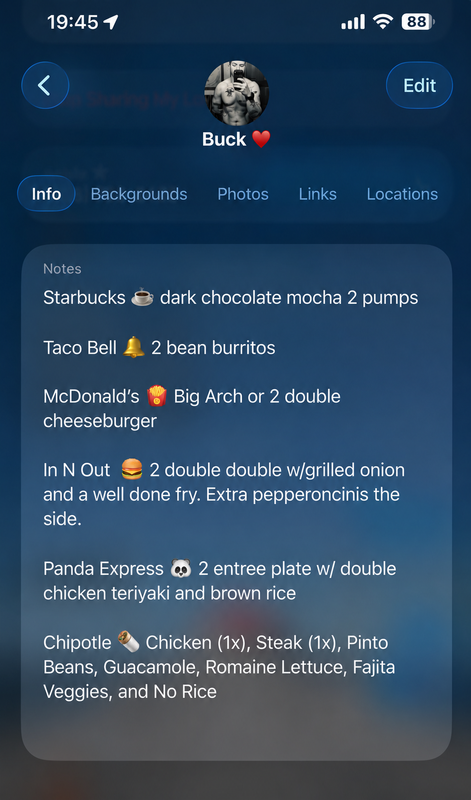
Buck reads it.
Eddie watches his face do what his face does. The eyes going wet at the corners. The mouth doing an upturn — the one Eddie has, over the years, come to understand as Buck’s I am being seen and I don’t know what to do with it face, the one Buck does not, in front of most people, deploy. He holds the phone for a long second.
Then he hands it back, and he turns Eddie’s chin up with his hand, and he kisses him.
Slow.
Eddie melts into it the way he has, since the very first time Buck kissed him in his kitchen for the first time, melted into it. His hand comes up to Buck’s jaw and Buck’s hand goes into his hair and the kiss deepens — careful, unhurried, the kind of kiss that is not, in itself, going anywhere in particular but is, in the way of these kisses, opening a door.
Buck pulls back an inch. His mouth is wet. His eyes are still a little wet.
“Eds.”
“Mm.”
“We have time.”
“What?”
“Before Chris gets home. We have time.”
Eddie’s whole body — registers this. Reorganizes around it. He looks at Buck. Buck’s face has gone, in the last three seconds, the specific kind of slow heat that Buck’s face goes when Buck has decided something. He is, Eddie clocks, smiling. The smile is not innocent.
“Buck.”
“Mm.”
“We have — what, an hour?”
“Hour and some change.”
“Buck.”
“Eds.”
“You — “
“Are you gonna sit there or are you gonna come kiss me properly?”
Eddie sits up enough to lean down. He kisses Buck — once, slow, with intent — and Buck’s hands come up under the back of Eddie’s shirt, warm flat palms on the small of his back, and then Buck is sitting up under him, and Eddie is being pulled up with him, and Buck — Buck just stands, and Eddie’s legs reflexively come up and wrap around his waist, and the throw blanket falls off them onto the floor.
“Hold on, Eds.”
“You don’t need to carry me — “
“Watch me.”
Buck is laughing. Eddie is laughing — the slightly winded laugh of a man being lifted off a couch by his very stupid, very strong boyfriend — and Buck has one hand under Eddie’s thigh and the other on his back and is walking, with the calm confidence of a man who knows the layout of his own home, down the hall.
Eddie’s mouth is at Buck’s jaw. Then at his throat. Then at the soft place under his ear that Eddie has learned, is the place that makes Buck’s breath go a little broken.
Buck makes a broken noise.
“Eds — Eddie, baby, I will drop you — “
“You won’t.”
“I might.”
“You won’t, Buck.”
He doesn’t.
He carries Eddie down the hall, the bedroom door already half open from earlier, and the lamp on the nightstand still on in the dim of the early evening, and the bed where, four nights ago, Eddie had been shown a note that has, in the time since, rearranged a part of his life.
Buck sets him down on the bed, their shirts come off immediately after.
The phone, on the couch in the living room, stays face-down. The TV stays paused on the opening of Naked and Afraid. The empty In-N-Out cup stays on the coffee table.
Inside Eddie’s phone, in the notes under Buck’s contact, a carefully curated list of how to take care of Evan Buckley is waiting for whatever Eddie writes next.